Clean your Jewellery Regularly – Part 2

A continuation of one of our Blog Posts from April! See link below for our previous post.

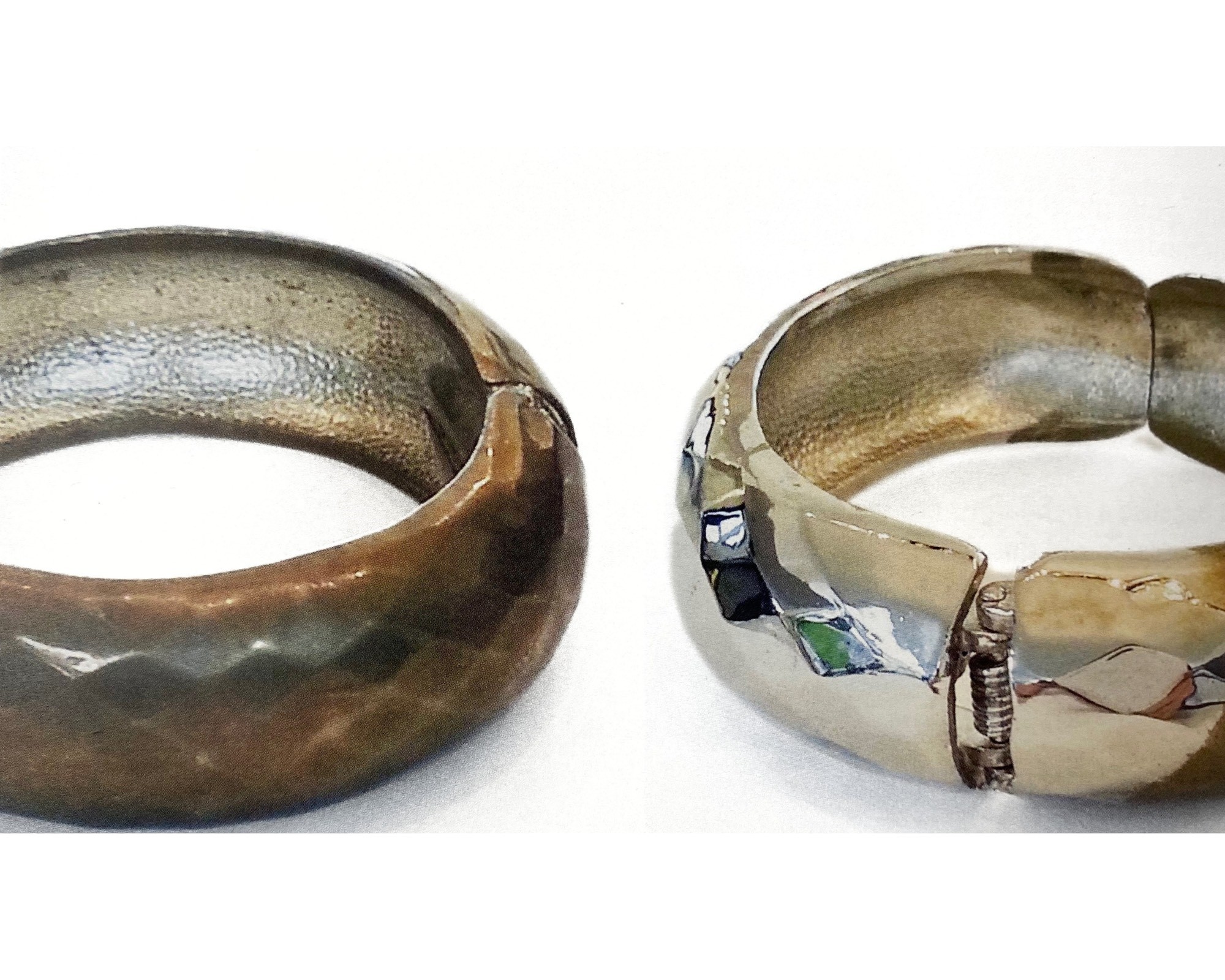
Another product that is often used to remove tarnish is a chemical dip.

This is the harshest home removal method and proper care and consideration should be taken before using it. Dips are strong chemicals that can take off a fine layer of the metal (be aware they can remove plating over time and corrode some gemstones) but can also deposit a thin layer of chemicals that are difficult to remove.

If this thin film is not removed in the cleaning process the jewellery will tarnish faster than before, creating a cycle that will necessitate more frequent cleaning of your pieces.

To remove this layer of cleaner, pieces must be rinsed for a long period of time under clean water until the film is gone.

Chemical dips are corrosive, and gloves should always be worn when using them. As they are a strong cleaner for jewellery, they can damage some stones.

’20 Tips on maintaining our Jewellery’, Gillian E. Batcher, 2013

Laura’s Introduction

Hi fellow jewellery-lovers! My name is Laura Papworth and I’m a summer intern here at Jewel Envy. I’m going into my second year at George Brown in the Jewellery Arts program. Now that I’ve learned many of the technical skills that are integral to goldsmithing, I’m excited to get started on projects of my own which I envision will have lots of colour and fun shapes. My favourite project I did for school was a bezel set pendant. I’m very eager to experiment with more gem setting in the future. All of the jewellers here at Jewel Envy have amazing work that I’m already feeling very inspired by.

Bezel Set pendant made out of Sterling Silver and Spinel stone
Sterling Silver cast ring
Rhino design of pendant for competition

OCAD University GradEx 2023

I had the opportunity to check out OCAD Universities GradEx exhibtiion this month, specifically the MAAD Departments Jewellery Graduates. See some of my favourite images below!

Beautiful kinetic jewellery by Zoey Zhang
Carrie Jiawen Ye
Angela Tian Qi Yang
Sadly this last student did not have any labels nor could were they labeled on the department social media!

I encourage anyone reading this to take a look at https://www.instagram.com/ocadumaad/ for much better photos and more detailed images! There were many more students I was not able to include here!

Alex

Pick a Posie

Showers bring flowers.

It is true in life, it is true in our hearts, and it is true at Jewel Envy.

Mother’s Day is next weekend (yes it is!), and the flower vendors will be ready, so we have picked out a beautiful bouquet of bloomy baubles for all of the Babas and Mamas in every genre.

We know exactly what we have in stock and what can be made within your timeline and budget, so don’t be shy to tell us what you are looking for when you drop by. This is what we do!

Clean your Jewellery regularly

The Basics of Jewellery Care: Clean your Jewellery regularly

For years of wearability, jewellery should be cleaned frequently. It is not advisable to let a thick coating of black tarnish build up on your jewellery as it can eventually eat away at metals and create permanent damage to the piece.

There are a variety of methods for cleaning Jewellery. For light tarnish a polishing cloth is the least abrasive method. There are two types of polishing cloths, plain and with rouge embedded in them.

Plain Cloth (Left) – Rouge Cloth (Right)

A plain cloth is perfect for weekly cleaning of your pieces. It must be a cloth designed for cleaning jewellery as the fibers in these cloths will not scratch the metal.

You would be surprised that some cloths can actually put scratches into silver and gold jewellery as they have hardness greater than the metals. Use a polishing cloth by rubbing it over the surface of your jewellery. Chains can be pulled through the cloth as you pinch them lightly between the cloth in your fingers.

For a slightly heavier cleaning use a cloth embedded with rouge. Rouge is a polishing compound used in the final stage of finishing jewellery. It can be used on all metals and on most gemstones (check with a jeweller first). After rubbing your jewellery with the rouge embedded side of the cloth rub the jewellery with the non-rouge side of the cloth to remove the compound. Wash your hands well after touching rouge as it is a strong chemical and can easily transfer to other items you subsequently touch.

If you find that the cloths are not removing the tarnish the next step is a metal cleaner that is rubbed on with a sponge under running water. Polishing compounds such as this remove a thin layer of the metal in the process of removing the tarnish. Be careful if you are cleaning plated jewellery as repeated polishing will remove plating over time.

’20 Tips on maintaining our Jewellery’, Gillian E. Batcher, 2013

Quick Emerald Facts

Emeralds are green stone, highly valued for its moss green or forest green colour, though as mentioned by the Gemological Institute of America;

“Gem experts differ on the degree of green that makes one stone an emerald and another stone a less-expensive green beryl. Most gemologists, gemological laboratories, and colored stone dealers call a stone green beryl when its color is “too light” for it to be classified as emerald. Even among that group, however, there’s a difference of opinion about what’s considered “too light.””

A handful of rough Emeralds from Colombia

As mentioned in the quote above, emeralds are the name we give certain colours of Beryl, a family of minerals which comes in a variety of colours, some useful for jewellery purposes, and some too fragile.

This Brazilian Morganite is also a type of beryl!

Emeralds can be either naturally mined, or made in a lab. Lab grown emeralds tend not to have the ‘jardin’ (the internal inclusions which give it its mossy look), though this does make them less prone to breaking during gem setting.

Emeralds are often cut octagonally, sometimes referred to as ’emerald cut’ due to how common it is. These stones can present a large challenge for setting in metal. Although they are a ‘hard’ stone for a coloured gemstone, they are often riven with internal flaws and inclusions which creates an unstable material prone to breaking.

A 3.25ct emerald by Lagaro Jewellers

Although beautiful emeralds should only be cleaned with a soft brush, and a light soap to prevent damage!

A Sneak Peak at Our Upcoming Auction!

On April 1st, Jewel Envy will be hosting an online auction!

Shafiq Sarwari, a goldsmith here at Jewel Envy, has been working to help bring his family to Canada. Currently living as refugees in Pakistan, Jewel Envy wants to help bring Shafiq’s family safely to Canada so that they can live without persecution of their beliefs.

Proceeds raised through our auction will support the Group of 5 sponsorship for his family’s move, as well as the local goldsmiths who work out of the Jewel Envy studio.

Here is a sneak peak of some items that will be featured:

Ring by Jack Donovan
Hoop Earrings by Kathy Winfield
Necklace by Maddie Kingston
Brooch by Edna Milevsky

More information on the auction to come this week – stay tuned!

Turning weapons into treasures.

Aurora Simmons uses inspiration from historical weapons to create elegant statement jewellery for people who want to stand out from the crowd. many of these objects are uniquely beautiful even though they have been used for violence in the past. Re contextualizing them as jewellery allows us to reclaim our power and helps us connect to the artisans who created the originals.

You can view more of her work at https://www.handmaderevolution.org/

A parang Machete necklace in brass, sterling silver spearrings based on a 14th c original and a polaxe brooch in brass.

Or follow her on Instagram and Facebook at handmade revolution_to

×
Product added to cart

No products in the cart.