Congrats Grads

There are many times of the year that people can graduate from their studies and programs, but social media feeds are certainly full of scholarly pride at the moment.

When my own daughter was finishing her last year of high school and choosing university, I thought of a way I could use my craft to celebrate her work and focus on what was ahead. I created rings with themes that subtly referred to tassels and books to celebrate graduating. Instead of nondescript designs, or rings so striking, she looked like she was celebrating a winning touchdown, I wanted to gift her a ring that would mean something special to her, based on her achievement and her goals… that she would actually wear.

This year, she is about to graduate with a Ba Hons, with sights on two separate Master’s degrees in the future, so I am thinking about these rings again. As stacking rings, she can continue to wear her tassel ring from high school, add one for her Ba, and later, one for each Master’s.

We can use Stirling for her understudies and gold for her graduate studies. We could use tassel rings all of the way, or book rings with a name of a degree on each one.

What combo would you choose?

You can find my handmade focus/grad rings at Jewel Envy, under Jennifer Trotman/Frekkeldesigns. I have some sizes/designs already in stock, and can make more in the metal/size of your choice, come by with a loved one in mind, or to try one on yourself. We can also create a wish list, so that someone can drop by and pick up a grad ring to your exact specifications.

Do you have another life goal to celebrate or achieve? Make an appointment to see me at the studio, and I’ll be happy to design something that suits your needs.

Thank you,

Jennifer

Set for Summer Nights

As always, our goldsmiths are putting new work on display. Some are preparing for outdoor exhibitions and markets, some for indoor shows. Universally, we are ready for warm summer weather and the jewellery that comes with it.

Drop by soon and see what is new for the season, such as this Stirling Silver set featuring a Sonoran turquoise with natural occurring pyrite matrix flakes:

May Birthstones

For the month of May we celebrate two luscious green stones: emerald and chrysoprase.

Emeralds are formed when chromium, vanadium, and iron are present in the mineral beryl. The varying presence of these three elements gives emerald its range of color. Chromium and vanadium make an intense green color. Iron gives the stone a bluish tint. Source: https://www.gia.edu/seeing-green

Chrysoprase, a variety of chalcedony, derives its colour from nickel. Source: https://www.gemsociety.org/article/chrysoprase-gem-information/

Back from Mexico City!

El Bazaar Sabado! Exploring San Angel, filled with and open market of crafts people and artists.
Beautiful Chapel
I purchased these incredible filigree earrings at the market from Alma Filigrana
In and around Coyoacán, the birth place of Frida Kahlo.
Inside La Casa Azul, Frida Kahlo’s family home. The center is an amazing open space filled with native plants.
Unfinished Frida Kahlo self portrait.
One of Frida Kahlo’s necklaces.
Frida Kahlo’s studio
Spotted at the National Anthropological Museum of Mexico
Obsessed with this sacrificial knife – I have never seen anything like this before!
CHURROS!
I am about to eat fresh churros!!!
Me and some MASSIVE agave.

Recycling Metal

Ever wondered what the process of recycling metal looks like? Here at Jewel Envy we can take your old jewellery and turn it into something new by melting it down and reusing the metal to create new pieces! Take a look at the photo process captured by of one of our resident goldsmiths Jamie Rosario pouring a wire ingot from her scrap silver to make a ring.

Approximately 25 grams of scrap silver is cleaned and cut up into small pieces and melted in a crucible. The steel mould is prepped and ready for molten silver to be poured into. The metal is heated until glowing red and must be poured in one swift motion into the wire mould!

This is what the metal looks like immediately after it has been poured into the mould and cooled in water.

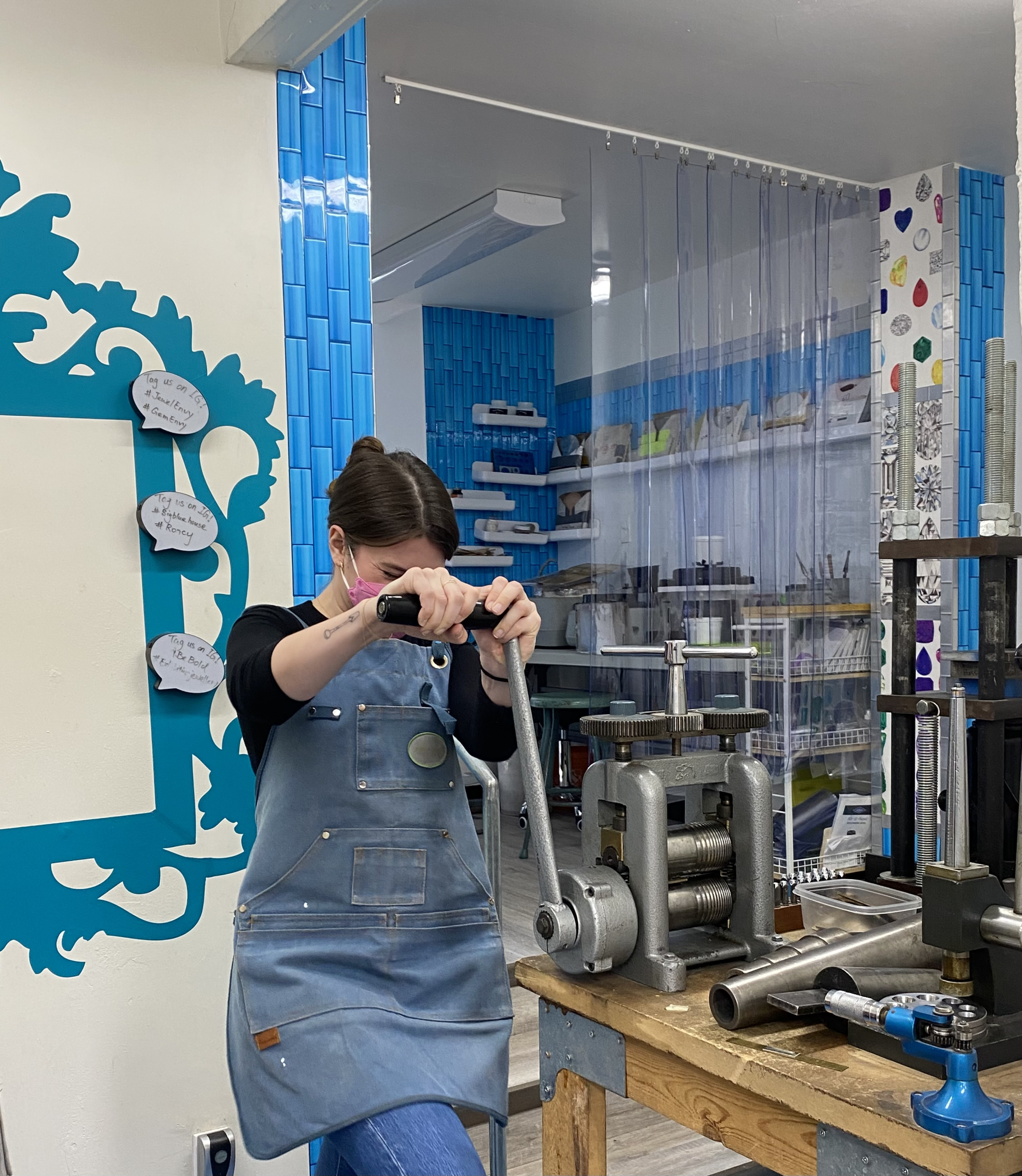
The ingot is then reduced in size and squared off with a hammer before is gets rolled through a wire mill by hand, where it can be reduced to your desired thickness.

The wire must be annealed (heated) every so often while being rolled through the mill so that the metal does not crack and stays pliable during the reduction process.

Making two different thicknesses of wire.

Here, the wire has been flattened and texture has been added with a ball pein hammer for a custom ring order.

The Difference between Handmade and Manufactured Jewellery

Photo of Edna Milevsky’s work. Handmade by her.

In my line of work as a handmade jewellery maker, I get asked by some when attending shows why the price of my work is that high.

Ever since the influx of cheap, shiny and very affordable jewellery has swept in from many jewellery factories in China through aliexpress/ alibaba and temu to name a few, it is readily available anywhere you go.

Handmade jewellery is made by skilled artisans using traditional methods. The results are unique and often intricate. Custom orders are common, making it one-of-a-kind and also allows for more customization opportunities. With handmade jewellery, we use intricate techniques and details, resulting in pieces with greater artistry and craftsmanship. With handmade jewellery, the metal is often made with higher quality materials and specially sourced stones to ensure durability and longevity. Since it is handmade, it is slower production. Sometimes a piece can be time-consuming since each piece is crafted by hand. Therefore it can impact the price and availability. Handmade jewellery is priced fairly to offer the artist a living wage. Last but not least, buying handmade jewellery supports small businesses and individual artists who put their passion and skills into their work.

For mass produced jewellery, they are less expensive and more readily available. They are usually very consistent in design and size because they are mass produced in an automated production process. To make it more cost effective, it may lead to cheaper materials or processes, impacting quality and longevity. Also, mass produced are usually based outside of Canada where they do not pay their workers a fair wage.

Take your jewellery off before you go to sleep!

Take your jewellery off before you go to sleep!

It may sound obvious, but many people are in the habit of sleeping with their rings on.

So why does this matter? Your hands often swell at night and if you are wearing a ring all the time you may become so accustomed to it that you might not realize it has drastically reduced the circulation to your finger, which can cause nerve damage.

Another problem may occur over time is that your hands can change around the ring, so that it no longer comes off at any point.

Both situations can lead to a trip to the hospital and end with a surgeon cutting off your ring.

If you like your ring, protect it and take it off at night.

’20 Tips on maintaining our Jewellery’, Gillian E. Batcher, 2013

End of March round up

Photos from a few bits and bobs being worked on by moi, Alexis Kostuk:

Hand carved mother of pearl
Was going to keep this as a sample, but feel in love with the asymmetric shape and rainbow glint of the nacre so I had to make it into a pendant.
Random snap shot of three separate wax carved pieces that also resemble the eye of a rooster when put together <o>
1 finished micro mosaic skull pendant, and 1 unfinished.

1/2 Day Cuff Workshop

Looking for a short and fun weekend activity with the chance to craft your own custom made jewellery? Our 1/2 day workshops might be a great match for you!

This Saturday at Jewel Envy we ran our 1/2 day cuff-making class where students learn to texture metal in a variety of techniques and apply them to their own hand-forged cuff. You can make your cuffs using a combination of silver, copper, and brass.

Today both of our students applied a ball pein hammered texture and used stamps for their cuff designs.

Snippets of the process:

Looking at metal selections and sample textures. Students have the chance to test out a few textures before deciding which one(s) to apply to their cuff!

Testing out different stamps.

Using the rolling mill to emboss textures and/or imagery. Textures can be imparted from several different materials such as textiles, metals, sandpaper, and even dried leaves! Your choice of texturing material is layered on top of your metal and are rolled through the mill together. The pressure of the mill imprints the texture from the material.

Touching up the form of the cuff using a soft mallet to prevent damaging the design on the cuff.

×
Product added to cart

No products in the cart.