Jewellery for National Love Your Pet Day

Hello Jewel Envy readers,

Did you know that today is National Love Your Pet Day? I know a lot of people aren’t fans of all the national whatever days, but who can hate a day dedicated to giving your pet a little extra love and attention? So, today I thought I would share a few ways you could have your furry (or feathery, or scaly or whatever else you’ve got) friend recreated in the form of jewellery.

Casting:

The very first casting project we had at OCAD was to model a dog in wax and then cast it in bronze. So naturally that process always comes to mind when I think about replicating an animal. Casting is a great method for portraying a specific pet because it allows for a high level of detail that can really capture an animal’s likeness as you can see in the two examples above. It’s important to consider what features you want to highlight and whether it’s better to show your pet in full like in this adorable Pomeranian Ring by Ham Ji Hee or opt for a portrait option to get those face details just right as seen in the custom Boston Terrier pendant by Kotoba Jewellery.

Hand Fabrication:

Hand fabrication is also a great option for portraying a pet and can range greatly in complexity. As you can see from Stick Man Creation’s Guinea Pig Pendant above a piece doesn’t need to be highly detailed to capture the likeness of a particular pet. Two flat pieces of metal do a wonderful job here of replicating this guinea pig’s expression. Hand fabrication can also go to the other end of the spectrum and become hyper realistic as you can see in Elizabeth Goluch’s Tarantula piece, Daisy, which is so detailed it even includes individual hairs on the spider’s legs and abdomen.

Enamel:

The earliest known enamel jewellery has been dated to around the 13th century B.C. and has been used to represent everything from flowers to important historical and religious figures. If the French aristocracy could have themselves portrayed in enamel pieces, then why can’t your pet? Well it turns out they absolutely can. Above are two examples that use the enamel technique of cloisonné to portray animals. The first, a pendant by Julie Glassman featuring the portrait of a pet cat and the second a fancy guppy with a beautiful blue chalcedony tail made by Jill Tower.

Butterfly Brooch by Helena Perez Lafaurie of HPL Jewellery Design
Shark Bracelet by Alexis Kostuk of Glaciale Goldsmith

Just for fun, here’s a couple of animal pieces we currently have on display at the store, maybe not the most common choices for pets but, cute nevertheless! I hope this has given you some inspiration, maybe like me you’re now debating which option would capture your pet best. Remember, our capable goldsmiths are always ready to whip up something custom if you’re looking for the perfect piece to celebrate your pet! Happy National Love your Pet Day everyone!

-Skye

Symbols of love

Well, Valentine’s Day may be over, but I think it’s always the season of love! I thought today I’d talk a bit about different symbols of love. Symbols that have been realised in jewellery, include the Claddagh ring (traditional Irish ring for love, loyalty and friendship).

From Wikipedia: https://en.wikipedia.org/wiki/Claddagh_ring#/media/File:Claddaghring.jpg

Roses are another popular symbol, and I love the way the different colours mean different things (you can read about some modern interpretations here, although there are lots of other places to find information about this!).

Of course, there’s always the ever popular heart shape (the ideograph and the anatomically correct)!

Alexis Kostuk @glacialegoldsmith

The infinity symbol is also quite popular!

Perhaps less well known are the shell and apple. Of course, there are lots of others, these are but a few examples.

I’m just going to finish off with one of my favourites: the Welsh love spoon. I saw these for the first time on a trip to Wales some number of years ago, and the images of them have stuck with me since. Romance and I have been on a bit of a break, but I’m feeling inspired, so there might be some new designs in my future based on these….

from: https://commons.wikimedia.org/wiki/File:Love_spoon.jpg

In any case, have a great Saturday! Until next time!

Robin

Diamonds

Ever since diamonds were first discovered in South Africa, they have found their way into our culture as symbols of love, status and wealth.  After years of research, geologists and scientists have a better understanding of how diamonds form in nature. It is believed that the right conditions for diamonds to be created are at elevated temperatures of 900°C to 1300°C in combination with an extremely high pressure of 650,000 psi to 850,000 psi.

In nature, there are only certain places that provide conditions like these and that’s deep within the Earth

In fact, most diamonds form inside the Earth’s mantle under parts of the continental crust called cratons. These provide stable environments that allow diamond crystals to grow over millions of years.

And it’s no coincidence that cratons are found in continents like Africa and Australia which also happen to be the biggest producers of gem-quality diamonds in the world.

Diamonds, aquamarine, white gold ring. hplagaurie.ca

Diamonds can be created by asteroid impact too.

When an asteroid strikes the Earth’s surface, the epic collision creates a massive explosion of heat and pressure on the ground. Carbon based deposits in the impact crater can get turned into tiny diamonds in an instant.

The Popigai crater in Russiais a spot which was struck by a large asteroid millions of years ago. And the immense pressure and temperature generated by the impact turned the surrounding metamorphic rocks and graphite into diamonds.

There are diamonds from deposits of meteorites fall too, Besides creating a spectacular sight in the night sky, meteorites also deposit their contents onto the ground when they hit the Earth’s surface.

The first scientific breakthrough in man-made diamonds came in 1954 when General Electric developed a process  that successfully replicated the conditions for natural diamond formation.

This process is called High Pressure High Temperature (HPHT) and involves the use of seed crystals which are grown in super-heated anvils.

Diamonds are incredible meaningful stones, the sizes, the colors, the shapes, the prices, even the qualities can be innumerable, but the only thing that made them incredible is the love that surround them. 

At jewel Envy we can created for you or for your love one an incredible piece of jewelry with diamonds that will keep its  meaningful   value for ever.
From design, to making, to selling, we do it all on site for your convenience.

Have a nice Sunday

Helena

Amethyst – The Regal Stone that was Dethroned

Raw amethyst crystal

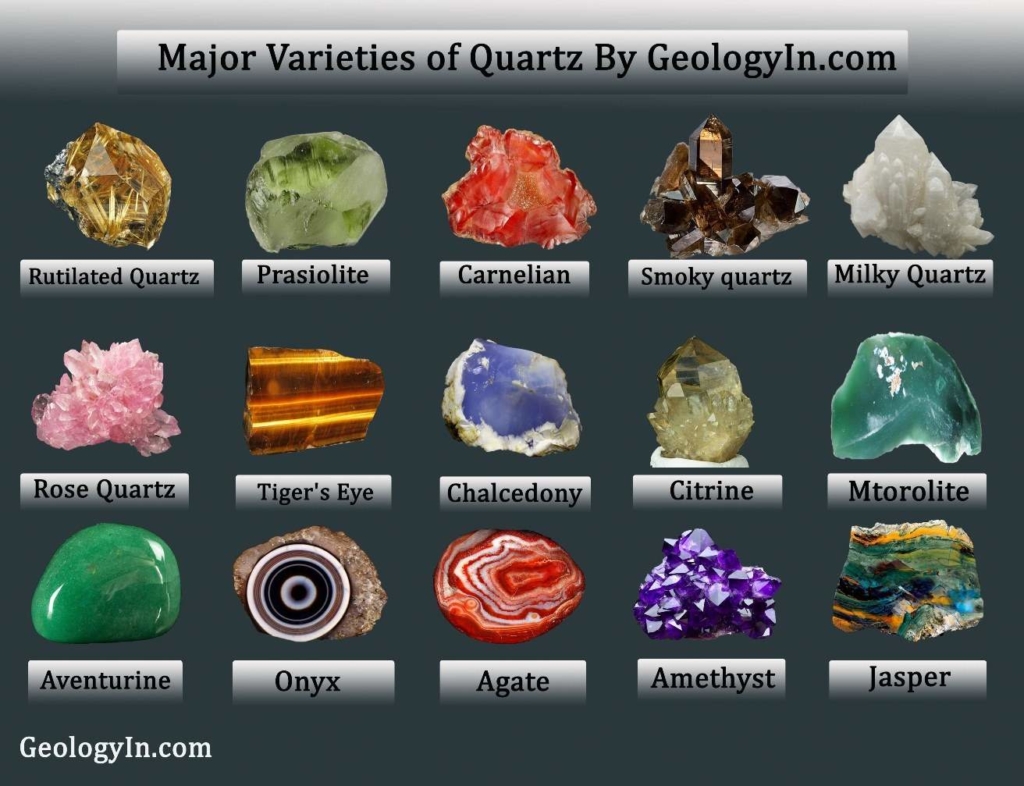
Another month another stone. Amethyst is the “traditional” birthstone for February and is the well known purple variety of the mineral quartz. Quartz, also known as rock crystal, is quite an interesting mineral, as it comes in many varieties, shapes and crystal habits.

From a geological point of view, this makes sense as quartz is made of the two most abundant elements in the Earth’s crust, oxygen at 46.6% and silicon at 27.7%, with a chemical formula SiO2. Anyone else see the 2:1 ratio here? If you want to really get to the scientific classification of minerals, this is how you could list amethyst. 

Amethyst is identified as:

  1. Trigonal Crystal System (which is lumped into the Hexagon System do to the 3-fold symmetry). The Crystal System should never be confused with crystal habit. Habit is how the system will crystallize depending on the environment.
  2. Silicate Composition
    • Framework silicate Sub-class
  3. Quartz/Silica Family
  4. Mineral = Quartz – SiO2
  5. Variety = Amethyst.
Photographed for the CIBJO project from the Dr. Eduard J. Gubelin Collection. Suite of cut quartz, left to right: GIA collection# 33384, 23.69 ct colorless rock crystal quartz, round cut; GIA collection# 33425, 36.84 ct smoky quartz octagon; GIA collection# 33450, 16.93 ct octagon smoky quartz; GIA collection# 24529, 26.57 ct rutile quartz from Brazil; GIA collection# 33391, 10.58 ct baguette colorless rock crystal quartz with black rutile needles; GIA collection# 33401, 12.82 ct rose-red oval rose quartz; GIA collection# 33386, 21.03 octagon rose-red rose quartz; GIA collection# 33427, 6.52 ct oval green prasiolite; and GIA collection# 33457, 10.76 ct brown/violet ametrine octagon from Anahi Mine, Bolivia.

Other known macro-crystalline varieties of quartz are; citrine, rose quartz, smoky quartz, rutilated quartz, milky quartz, prasiolite and ametrine. All of these varieties are classified are actually quartz but with different colour impurities.

Now, what do I mean by macrocrystalline? Well, quartz has the ability to create large, solid crystals and it can crystallize as tiny micro-crystals or spheres. These microcrystalline quartz varieties include agate, chalcedony, chrysoprase, carnelian, onyx, sardonyx, jasper, aventurine, bloodstone, tiger’s eye and moss agate. These varieties of quarts come in many colours, but that will be a blog for another month If you want to dig even deeper there are several sub-varieties of quartz characterized by temperature and pressure during crystallization. 

But what makes amethyst purple, well that is due to the presence of iron, and some other trace element impurities within the crystal lattice/structure. Add a touch of radiation and voila, purple! Then if you want, add some heat of about 300-400 celsius and you will lose the purple and make citrine. SCIENCE! Interesting note, most citrine you see is actually heat-treated amethyst.

Amethyst, citrine, rock crystal and ametrine all in one geode.

In the past, up until the 18th century, amethyst was classified as a cardinal gemstone, valuable gemstones that included diamond, sapphire, ruby, and emerald. This was due to its deep, regal purple hues. However, due to the discovery of extensive deposits in locations such as Brazil, amethyst lost most of its value. A perfect example of supply and demand when there is WAY too much supply. Amethyst price is not primarily defined by carat weight due to quantity. Instead, the colour is the biggest factor in determining the value of amethyst. The highest grade amethyst, called “Deep Russian” or “Siberian” is exceptionally rare but the value is still determined by the demand and is still much less than diamonds and sapphires.

Facetted “Siberian” or “Deep Russian” amethyst, the richest and more traditionally desired variety of colour of amethyst.

This gemstone will always be precious and regal to me even if others disagree. Stay tuned for March when we talk about aquamarine, a variety of the mineral beryl.

Peter

Ever wondered what the British Crown Jewels are actually worth?

I don’t know about you, but lately I have been OBSESSED with Netflix binging all things ROYAL, and it has got me enamored with all the incredible tiaras, crowns and jewels. Researching the topic as a whole proved quite cumbersome, so I decided to focus on the Royals that are closest to home, more specifically, the British State and Queen Elizabeth II. I wanted to know more about the value of the “Crown Jewels” and on this snowy Sunday, I have decided to share what I discovered.

Queen Elizabeth II is the head of the British state and sovereign and the head of the monarch, or The Crown. The Crown owns a great deal of property, including The Crown Jewels, a collection of crowns, rings, scepters, vestments, and more, which often garner the most attention.

The crown itself is only one of many pieces making up what is referred to as “the Crown Jewels”. The Crown Jewels are the most resplendent and famous of the nation’s treasures.  Kept under the watchful eye of the Yeoman Warders at the Tower of London, they constitute the most complete collection of royal regalia in the world.  As a group, the Crown Jewels comprise a host of extraordinary items – from orbs, scepters and crowns, to gold and silver-gilt banqueting and altar plate.  All are intimately connected with the status and role of the monarch.  The oldest of these is the twelfth-century spoon used for the sovereign’s ritual anointing at the coronation.

One of the most well known pieces in the Crown Jewels is St. Edward’s Crown, which has 444 stones, both precious and semi-precious. Nearly five pounds of gold were used to construct the crown, which today would be worth more than $100,000; while the collection of stones in the precious metal likely place the value of this crown at approximately $39 million.

Her Majesty only wore the St. Edward’s Crown for a few moments as it is extremely heavy. Queen Elizabeth told Smithsonian Channel, “You can’t look down to read the speech, you have to take the speech up, because if you did, your neck would break and it would fall off.”

The jewels are said to be priceless. They are not insured either, which means they’ve likely never been appraised. However, estimates put the entire collection at $4 billion. Pretty incredible!

Let’s talk about garnets

I guess it’s fortunate for me that I was born in January, because I LOVE garnets (or maybe I like them because they’re my birthstone? who knows). Most people know them as a deep red colour, or a reddish-brown like this bead necklace:

garnet bead necklace with textured silver hollow form from House of Cassady

Did you realise, though, that they come in other colours, including orange and green?

orange garnet, sometimes known as mandarin, tangerine or spessarite (if you want to be more technical!) used from: wikimedia commons
green garnet, tsavorite (used from: wikimedia commons)

Garnets are silicates, and as with many crystals, the colour variation comes from the other minerals that are incorporated, for example, red can result from Aluminium/iron, while if it’s manganese/aluminium, a more orangey colour is the result. Interested in knowing more? There is alot of information available about garnets, but you can look here, or here to find out more.

On this dreary day, I’m thinking about the warm orange variety of garnet:).

Happy Sunday!

-Robin

Unique Setting

Today I wanted to share three images of work that take a unique approach to securing gems or other objects using gem setting techniques.

Regine Schwarzer using a simple tab setting to secure enameled plates.
Polly Wales casts pieces with the stones already in place. This only works on very heat resistant minerals.
Gilles Jonemann set a 5 carat diamond into small adjustable wrench using the tension setting technique.

Welcome Karyn, our newest member

Hello Jewel Envy family,

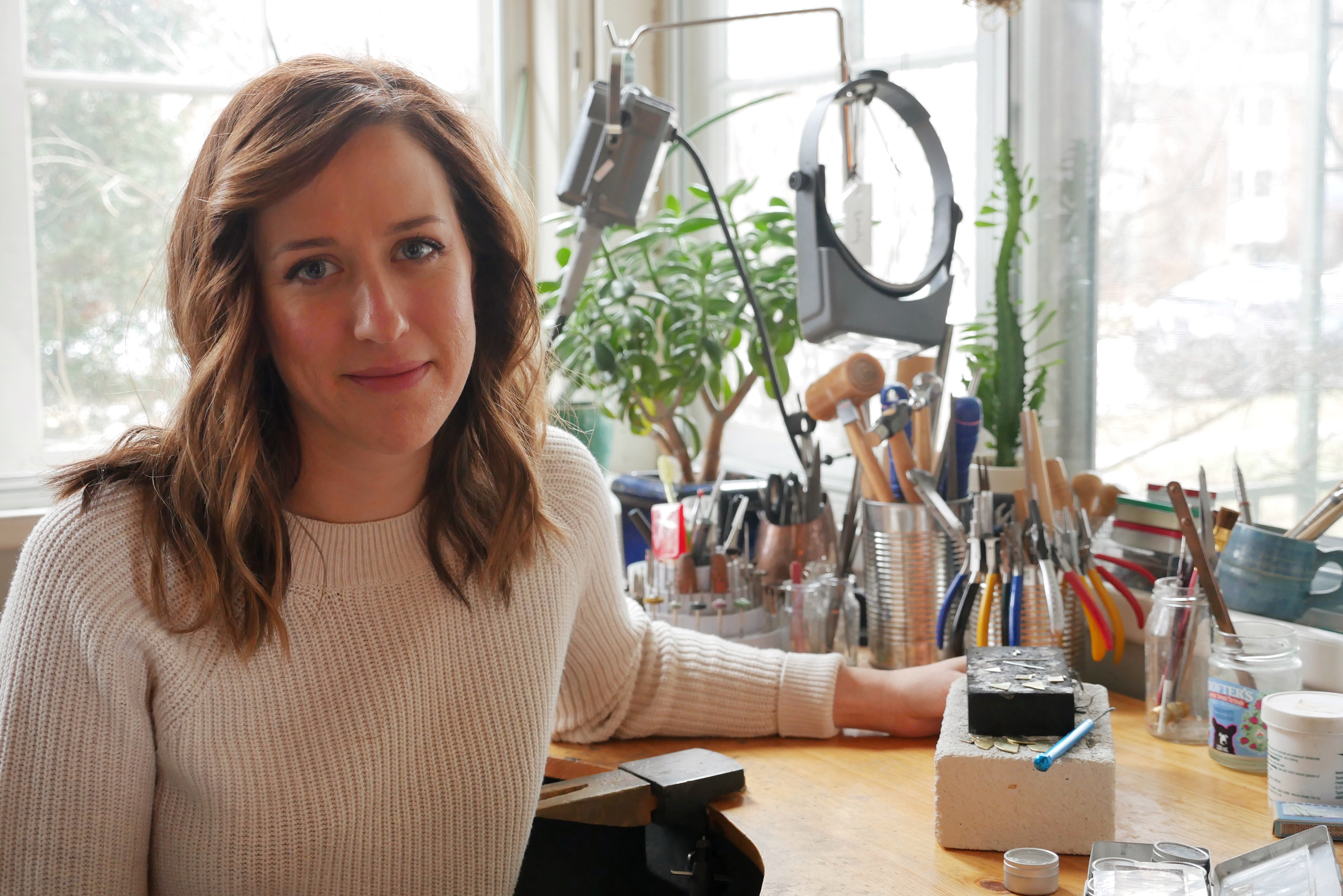
I am here to introduce myself, Karyn Houston, as the newest member of the studio.

It all begins in a land far, far away, a long, long time ago….

That’s me, at my bench at home, where I’ve been working on designs for my jewellery line sticks vs stone, since 2016.

How did you find your way into Goldsmithing?

I initially enrolled at Fanshawe College in London to study Audio Engineering, but after the first week it all felt very wrong, so I switched programs, and snuck in to the delinquent’s corner, aka the Art program, where I soon felt right at home.

I spent much of my self-directed final year working with paint.

Upon graduating, I followed my beloved Sculpture professor, Thierry Delva, back to his stomping grounding in Halifax, Nova Scotia, and attended NSCAD University to get my BFA. My major was sculpture, but I soon enrolled in classes in the Jewellery Design and Metalsmithing program in order to access their centrifugal casting set up, which would enable me to cast small objects in much higher detail than I was capable of achieving with the casting methods we used in the Sculpture program.

One day, as I was working on a piece, I had a vertiginous moment in which all the architectural and jewellery designing I had done on graph paper in my grandparents’ house as a child was suddenly and viscerally connected to the act of metal manipulation which I was currently undertaking, and I knew with certainty that this was what I was meant for. My path was clear.

After graduating, I travelled for a time, and lived in Melbourne, Australia for a handful of years. I soon discovered that not having a creative practice in my life was detrimental, and something I needed to avoid exploding.

Upon my return to Canada in 2014, I outfitted a jewellery bench in my home, and from there I have been working with metal ever since.

I would consider my aesthetic to be quite organic; evidence of the hand, imperfections, and allusions to natural processes are important aspects I aim to infer in the final design. A deeply rooted love of texture permeates my work.

Often times the creative process can be a very isolated one; the maker sits alone in their studio engrossed in their work for hours on end, only looking up and encountering others when looking to fill their belly or put on a pot of coffee. That’s why it’s important to have collectives, and studios, like Jewel Envy, not just for basic social interaction with other creatives, but to share knowledge and experiences with each other, and to foster a support network.

For this reason, and many others, I am excited to be a member of the studio, and look forward to creating, and engaging, in such a welcoming space.

Opening Happiness

Hello Sunday Readers,

When the days are cold, frosty and chilly like today,  I go to my cellphone and look for some of the photos that remember me that spring is always around the corner!

I have thousands of pics about so many things that give me strength to keep going and happiness to be a life.

Thousands of photos of my little one, Simon, the most incredible human been that came to our lives to give us all, faith and hope this world will be round and bright again!

My grandson Simon and his mom.

Many of them are jewellery’s photos, gorgeous pieces that I had made, incredible ones from my talented coworkers, like the one I will show you below, the lovely ones you see on a window shop or in a magazine and you will love to change your own way.

Persian Poem. Saeedeh Rahmati, Saeedeh Jewelery. Green Agate and Sterling Silver.

The translation of the poem is “I thrive on one thousand longings and each one is you”

One of the best parts of being a goldsmith is the beauty of been in love with what you do and keep learning every day to do it even better.

Saeedeh is an artist and her work inspire all of us.

I have too photos of the most amazing flowers we have back at home, the display is so powerful that you think it’s not real!  The colors, shapes, smells, sizes, always in my memory what ever I go.

Centro Comercial Santa Fe, Medellin, Colombia
Desfile de Silleteros, Medellin, Colombia

Even photos of fruits and legumes that smell like heaven! Colors that I can see if I close my eyes… when I need them the most.

Armenia, Quindio, Colombia

Open, look, sing, dream of what ever give you happiness and make of this Sunday a great day!

Thanks so much for buying local, for been with us all along the way!

Have a nice Sunday

Helena

Sun in a stone

Occasionally common minerals form crystals that shimmer like the light of the moon or a rainbow on a soap bubble. Called iridescence, this phenomenon is caused by light scattering, or diffracting, off closely spaced layers in feldspar crystals. Sunstones are one of the gems cut from these iridescent crystals. They exhibit a reddish to golden schiller, resulting from light reflecting off numerous tiny copper or hematite (iron oxide) flakes scattered within the stones. *(info from the Smithsonian)*

If you love moonstone or labradorite (both feldspar crystals) you might just love sunstones. I collected a few images from the old interwebs to give you a bit of sunshine through stones; you might not get vitamin d from them, but they will give you LIFE! – Alexis

sparkle, sparkle.

Showing off the range of colours.

Blurry, but still pretty ;o)

There is something about this shape and colour that just works beautifully. You can definitely see the coppery flash within the stone on this one!

Pretty pebble shapes.


×
Product added to cart

No products in the cart.