Welcome to a superb Saturday! With the continuing Health Crisis getting to us all, I’m grateful for days like today, when at least the weather makes me happy! Crisp, sunny, late fall days are my favourite – the temperature is cooling off, but it’s so sunny that it lightens my heart. Hopefully you feel the same! Or are at least out for some physically-distanced air, and stocking up on Vitamin D.
Living in the city definitely has its rewards, despite the drawbacks. One of the things I love (in my continuing journey of getting to relearn Toronto), is all the street art. Its become almost a game for me, spotting everything when I’m out and about.
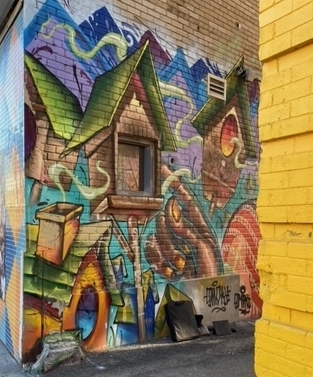
These are just a few of the things I spotted on my walk in this morning:
The art is whimsical, sometimes more meaningful, and colourful. Most of all, I feel inspired by the fact that it’s evidence that people care about their spaces, and that it’s also an initiative to support artists, and it brings them visibility. I think alot of it has been initiated through the StreetARToronto program. If you visit the website there are maps of where different pieces have been done–in this current age of trying to be physically distant,they make a great outdoor discovery adventure.
Friends of mine were inspired by the street art around Toronto, and wanted to support a local artist, so they commissioned this fantastic mural for their shed.
I hope you, too, will be inspired to support local artists and local small businesses as we come up to the holidays, either in person, or through online shopping. Did you know that we have just added alot of new work from all the members of Jewel Envy to the online shop? Pop over and check it out–and don’t forget that we take orders for variants on existing pieces and custom pieces as well! Send us a message to start a conversation.
Alessandra Pompei is an Italian Canadian jeweller based in Toronto, Canada. She creates fine jewellery, blends the highest quality materials with the ultimate level of craftsmanship, combined with personal narrative creating statement pieces that are not only aesthetically pleasing but engaging to the viewer. Her determination, devotion, and discipline results in functional fine art.
Gold für Eisen is a series of rings I created as part of my Iron Idenity collection, translating to Gold for Iron from German, these rings aim to explore what these factories and industrial sites meant, and to some extent, still mean to the city of Hamilton.
Photos by Greg Fraser
The Berlin Iron movement of the 19th century serves as a historical link for me, the idea of industrial material and aesthetics used in self-expression, as well as the subtler connection to loyalty to one’s city/state/identity which was encouraged by the Prussians during the time. Connecting this with the pride and loyalty many people have for Hamilton, though this pride is partly of its grimy industrial attitudes, has led me to look back at my home and upbringing.
The places and structures I reference directly influenced the culture of Hamilton. These former steel mills, manufacturing facilities and factories provided good working-class jobs, and were once economic symbols announcing the prosperity of the city. Now that we have moved into a post-industrial economy; transitioning into service-based industries, these places look dirty, out of place, and the desire to tear them down for new development is strong. I grew up around the last of these industrial sites when the flame of industry was already diminished. I feel compelled to record the physical and emotional identity of this city in order to come to a better understanding of my own identity.
2020 was not the year any of us expected and we have all had to make huge sacrifices to keep going. With many businesses on the brink of failure I feel truly lucky that Jewel Envy has survived and I know it is because of your support that we have been able to do so.
To stay in compliance with all of the health and safety recommendations we made a huge investment in our processes for cleaning and the installation of our UVC sterilization system. In addition to this we have had to reduce the number of classes we were able to offer in 2020 and reduce the number of people in each class.
Jewel Envy’s amazing instructors who are the resident goldsmiths have had a dramatic decrease in what was once a stable part of their income as they are paid per student to teach. To compensate for this moving forward I have chosen to increase the cost of classes so that the instructors can be paid more knowing they will have fewer classes in the coming year(s) and be teaching smaller groups (for a while).
All gift certificates that specifically say for classes and were issued before November 1st, 2020 will be honored as full payment for said class until March 31st, 2021 or the dollar value that class was worth at any time.
I fully support our goldsmithing family and feel that this price increase will continue to allow them to make the fabulous and uncompromising work they produce. I am a budget conscious person and always try to keep price increases to a minimum; this is only our second one in 14 years of business so I feel at this point it was necessary and fair.
I’m grateful to all of you and hope to see everyone in the studio or for an online consult some time soon.
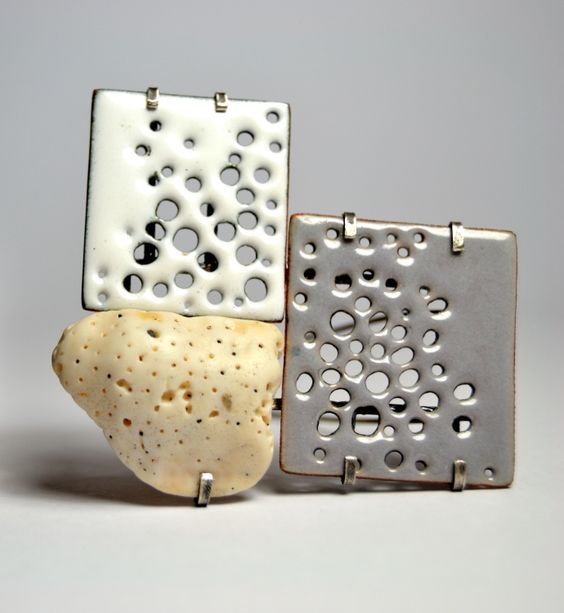
While I was compiling images for this post, I couldn’t just pick a single artist to concentrate on, like I’ve done in the past with my “Artists of Influence” posts. What I kept getting distracted by was images of artist’s work with absorbing and inspiring surface qualities. It seems only fitting that this directly follows Alex’s post, since his work is so …. deliciously textural.
So lets roll with that, and I’m just going to throw a kaleidoscope of textural images your way…
I based my series of large necklaces on this skyline of one of Hamilton, Ontario’s industrial sectors. Something about this gritty, chaotic, area of the city always stuck with me.
Generally it was always viewed from afar, across the lake while driving over the skyway on the eastern side, or seen in the distance along York boulevard from the western entrance. It was always in motion, day and night.
One of the many chemical plants inside the sectors.
These examples of Hamilton’s industrial past aren’t often seen in a positive light, but there was something that drew me back there time and time again. Something about the bright blues and red, caked in grime and the tell tale signs of age, contrasted with the bare utilitarian metal structures radiated an immense feeling of power to me.
The first three necklaces I made for the series. Photo by Greg Fraser
Photo by Greg Fraser
Photo by Greg Fraser
Photo by Greg Fraser
I hope you’ve enjoyed this brief look into the inspiration behind my work
American Contra Luz Opal – The Galaxy Opal From Opal Butte, Oregon as displayed from Bonhams aucion.
October, the month of colour and spooks. As like the previous months, October has two gemstones associated with it as well. We have the choice of opal or pink tourmaline for October babies and as you can tell from the title, I will be informing you about opals.
Opal is a very interesting gemstone. It is referred to as a hydros amorphous silicate, with the chemical formula SiO2 · nH2O. While it is similar to quartz, it’s the presence of water and the structure of the silica or quartz that’s different. The n refers to a range of water present, roughly 3 to 21% by weight, gem-quality opal is usually 6 to 10 % water weight. Interesting fact, because of its amorphous nature it’s actually referred to as a mineraloid. Amorphous means “without a clearly defined form or shape”. If you were to look at an amorphous solid on the atomic level, you would see nothing lines up in a continuous crystalline structure, it looks more like a liquid. Glass is also an amorphous solid.
Difference between crystals, micro-crystals and glass.
Etymologically, opal is derived from several sources. The actual English word “opal” is adapted from the Latin term opalus, meaning “to see a change of colour”. From what I’ve researched it comes from the Sanskrit word úpala which means “precious stone”. Another source refers to the Ancient Greek word from 180 BCE, opallios as a possible source. The Romans adored opal, it was prized beyond all other gemstones as its only source was from Hungary at the time. They marvelled at how it flashed all the colours of the other gemstones. Many cultures believed it was a gemstone that encompassed the spirit of all the other gemstones. Now there are many types, patterns and colours of opal hailing from Australia, Ethiopia, Nevada, Mexico and even Canada. Cool fact, in 2008, NASA announced that they even found opal on Mars.
The Virgin Rainbow opal, the worlds finest and most expensive opal sold. Mined from Cooper Pedy, the opal capital of the world.
Opal is identified as:
1) Amorphous Crystal System
2) Mineraloid Category
3) Silicate Family
4) Mineral = Hydrous Silicate → Opal -SiO2 · nH2O
5) Varieties = Precious Opal, Fire Opal, Potch or Common Opal.
Now it’s not hard to see why opal is so desired, a quick Google image search gives you HOURS worth of images to drool over of this stone. This stone is a phenomenon of physics as light interacts between crystal and water. But wait a minute, didn’t I just say it was amorphous?
An electon microscope image of common opal vs. precious opal. You can see the arangement of the spheres in orderly sections.
Well yes it both is and isn’t. Opal is actually made up of a bunch of tiny quartz spheres that range from 100 – 1000nm in diameter. These spheres can be stacked and arranged into a pattern or random and irregular. Water then fills the gaps between the spheres, aiding in the refraction of light into the quartz. When the spheres and gaps are within 150-300nm in diameter, light is diffracted by the spheres and a prism is produced. It’s similar to a rainbow caused by rainfall, a bunch of little prisms working together to refract white light and create a rainbow. Now when these prism/spheres are in random and irregular order, the light passing through interferes and instead we see the background colour. This is what we call common opal or potch and it can be equally appealing with pink, blue and green. Now, when the spheres are aligned, similar in size and packed together in packages, the light now isn’t interfering and we get precious opal. With precious opal, when you look into the stone the colours you see are directly related to sphere size. Red light = 300nm diameter spheres, while violet = 150nm diameter sphere. Also when the spheres are packing in order, then the spaces in between that are filled with water are also refracting light of the same wavelength, thus the flash is brighter.
The spectacular play-of-colour exhibited in natural opal is caused by light interacting with millions of sub-micron silica spheres neatly stacked within the opal. As light passes through these neatly-stacked spheres, it is diffracted into its component colours and exits the stone in a flash of spectral colours
A clearer image of precious opal with an electron microscope.
Now, due to the variety of colours and patterns within opals, they have their own unique appraisal system. They must look at the body tone, play of colour, pattern type, fire and clarity of the opal. Body tone is the base colour of the opal ranging from black to white. Play of colour is the gemmological term for the colour flash within opal caused by the arrangement of the silica spheres. Side note here, this is not to be confused with another gemmological term opalescence as they have different definitions. Play of colour is how light interacts with the gemstone to produce internal flashing rainbows. Ammolite and fire agate are other gemstones displays “play of colour”. Opalescence is the milky iridescence displayed by an opal. Chalcedony, rose quartz and moonstone will display opalescence as well.
Opalite glass.
Pattern type is how the play of colour flashes through the opal. Fire is how bright or dull the play of colour is compared to the body colour. Clarity is pretty self-explanatory as it refers to how translucent the opal is. Now, I can spend a whole day explaining the different varieties of opal but that will be for another blog. From my understanding and expertise in gemmology I can tell you one of the most sought-after opals is a black Harlequin opal.
Black Harlequin opal of exeptional value.
As all gemstones are precious and expensive, opal being a jewel among them, also have imitation and synthetic stones to watch out for. First, we need to discuss how opals are cut and set as opals are softer stones (5.5-6.5 Mohs) that are both brittle and susceptible to temperature changes. Opals come as a “solid”,” doublet” or “triplet”. For ease of understanding let’s start with the doublet. A doublet is when an opal slab is backed with black backing, usually onyx, glass or host rock. This helps protect the opal, and bring the colour out as the black adds to the contrast of the fire and play-of-colour. A triplet is similar to a doublet but the slab of opal is now a thin sheet and a clear cap of either quartz, glass or plastic. Triplets are used when the opal mineralizes in thin sheets within the rock, and there isn’t enough to make a doublet. Finally a solid as its name says a solid opal. Pricing varies as a solid opal is rarer and desired more than a triplet.
A visual explanation for solid, doublet, and triplet.
When you’re looking for opal jewellery be wary of this as some doublet and triplets look like solid opals. The best indicator is the price. Like with all gemstones, if the price is a really good deal that almost seems too good to be true, it just may now be what you think. Take a close look at the stone and check for a black back or a clear top.
For opal, there are imitations and treatments but no genuine synthetics. This is because the irregularity within is part of the desire and while there are “synthetics” they are more imitations because of the use of either bonding agents like epoxy or other chemicals not found in natural opals. Let’s start with treatments. There are several to be aware of and most of them are to help darken the body colour or increase durability and help with crazing. Crazing is a natural problem with opals as is a result of water loss and temperature changes. The result is fractures throughout your opal that can lead to chipping or breaking the opal. Epoxy, oils and other bonding agents have been used to help seal the fractures and increase the clarity of the opal. This is known as resin treatments and can also be used to help with protecting the surface from damage as well. Another known agent used is aluminum oxide to help cost the opal and help with preventing scratches. This is actually helpful for your opals longevity but it should be indicated with purchase.
Crazing in opal.
Another treatment used for opals is to blacken the back body. Black body colour allows you to see the pay of colour better, hence it’s a higher price and the most common treatment for opals. Several techniques are used for this treatment: carbonizing, acid and sugar, charcoal burning and smoke treatments. Carbonizing involves impacting graphite into the pores and gaps within the white opal matrix. This treatment can be spotted in a microscope with the presents of black clusters or spots. Acid and sugar is a really interesting technique. This involved soaking or “cooking” the cut opal in a saturated sugar solution. Then after some time has passed the opal is removed from the sugar and placed in a concentrated sulfuric acid solution. The acid burns the sugar that soaked into the opal, creating black clusters within the stone. Again, with a microscope, you will see a peppery like texture on the surface and within the opal. Finally, the harcoal and smoke treatment are just as the name states. The opal is wrapped in newspaper or bark and ignited. The ask and smoke are absorbed into the water content of the opal and the stone appears black.
Before and after sugar and acid treatment of opal.
Closer look at a sugar and acid treated opal, you can see the peppery look of the colour.
Synthetics and imitation opals are an interesting bunch. For starters, any imitation with a name in front of it or using opal in the name aside from the obvious ones (precious, boulder, water, fire etc…) should be given a look over. There are many glass imitations like Slocum Stone that use polychromatic foil in glass to mimic play-of-colour. Another one I see a lot is opalite. Again this is just opalescent glass, there is no play of colour in the glass.
Slocum stone – glass and polychrom foil.
Synthetic opals on the other hand are made of silica and mimic the amorphous orderly sphere structure. Yet they are not really a true synthetic as many need to use a binding agent like epoxy or glass. These opals can come in a wide range of beautiful colours but limited to patterns. They are usually sold as “lab-grown” opal or they will use their names, such as the case for Gilson opal or Kyocera. The difference is natural opals will display a wider and more random array of colours and patterns. They may have inclusions from the host rock in as well, giving you strong evidence it is a natural opal. Synthetic opals on the other hand will appear spotless and display only two distinct patterns; harlequin and columnar. These patterns are a result of the growth direction from crystallization and with a microscope, you can see what is known as “lizard skin” or “chicken wire” texture. Naturals don’t display this kind of texture.
Couldn’t have said it better myself.
“Lizard skin” or “Chicken wire” texture in synthetic opal.
I have attached a few links for you to look through at your leisure if you are interested in learning more about opals and their patterns.
taken from: https://www.wikiart.org/en/salvador-dali
I love surrealism. It appeals so much to my sense of whimsy, and the sci fi/fantasy book loving geek in me! I’ve had a long fascination with Dali, and when I was going through my phase of visiting galleries round Europe in my late 20’s, I’d always be on the lookout for any offering from this artist. One of my favourite paintings is Persistence of Memory,although it’s unfortunately not one I’ve seen in person .
One of the things I didn’t initially appreciate was how prolific he was. Over his lifetime he created over 1600 paintings, to say nothing of the sculptures and other objects (like the Lobster phone).
The Lobster Telephone
https://commons.wikimedia.org/wiki/File:Lobster_Telephone_Photo.jpg ; user Nasch92
It wasn’t until I visited the Dali Paris gallery that I realised how interesting and strange the inside of Dali’s brain must be (in only the best way of course!). This was finally confirmed when I purchased (and read) his autobiography after visting Dali Universe London (Which, incidentally is a lovely venue by the banks of the Thames, just over Westminster Bridge), The Secret Life of Salvador Dali.
Apart from his art, one of the things that really stuck with me, was his daily practice of creativity. Not necessarily for any purpose, but just to let it out of himself, as if he couldn’t hold it back, and he’d make something out of almost anything. I love that concept, and it’s something I strive to practice too, although not on nearly the same scale.
How do you practice your creativity? Here’s a suggestion: why not visit us at the studio and learn a new skill or develop your existing ones in jewellery creation.
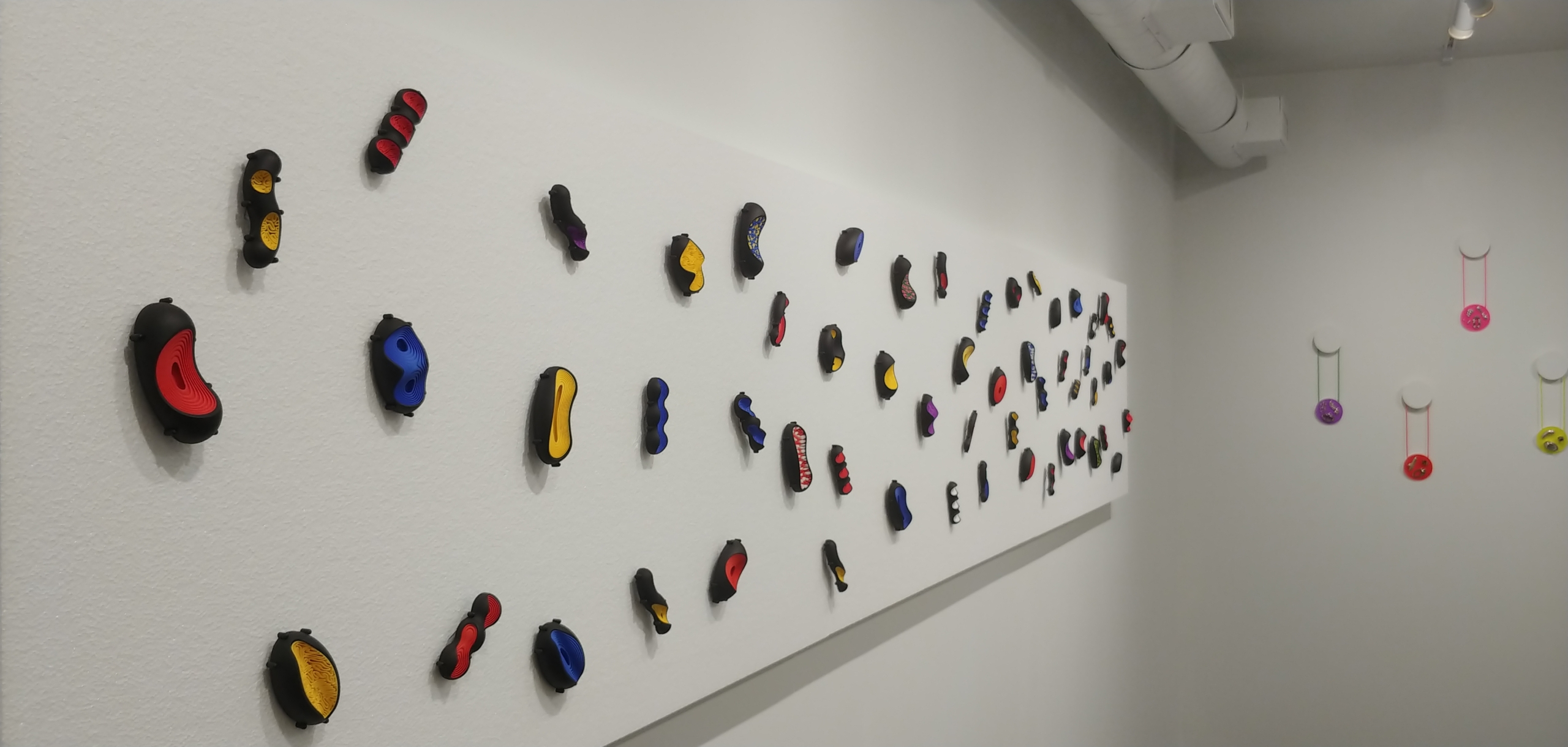
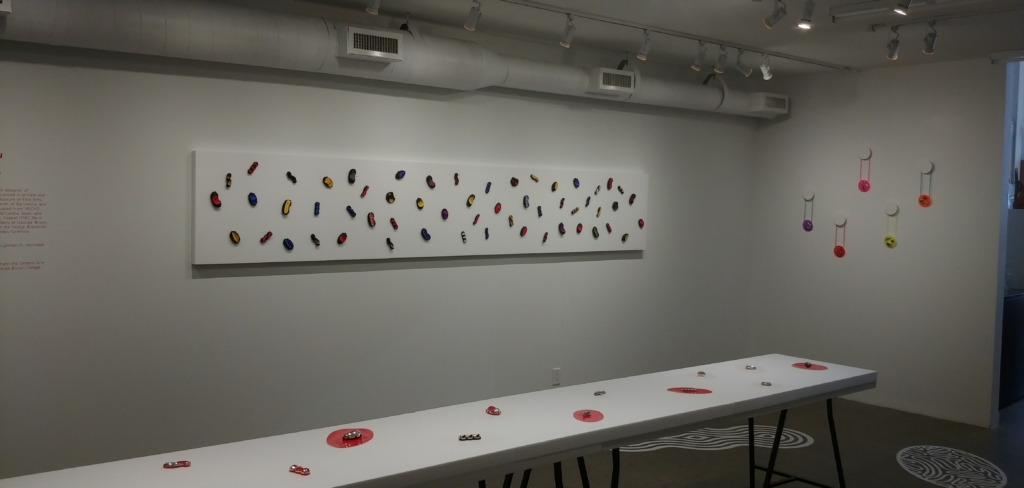
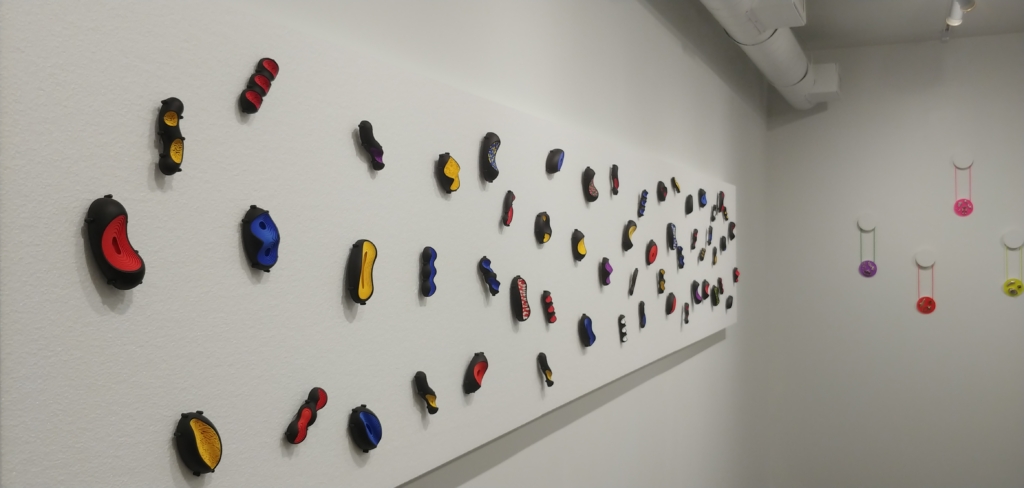
I had a chance to check out Paul McClure’s solo exhibition currently at the Craft Ontario gallery in Toronto, curated by Robyn Wilcox.
Paul has this to say about the exhibition:
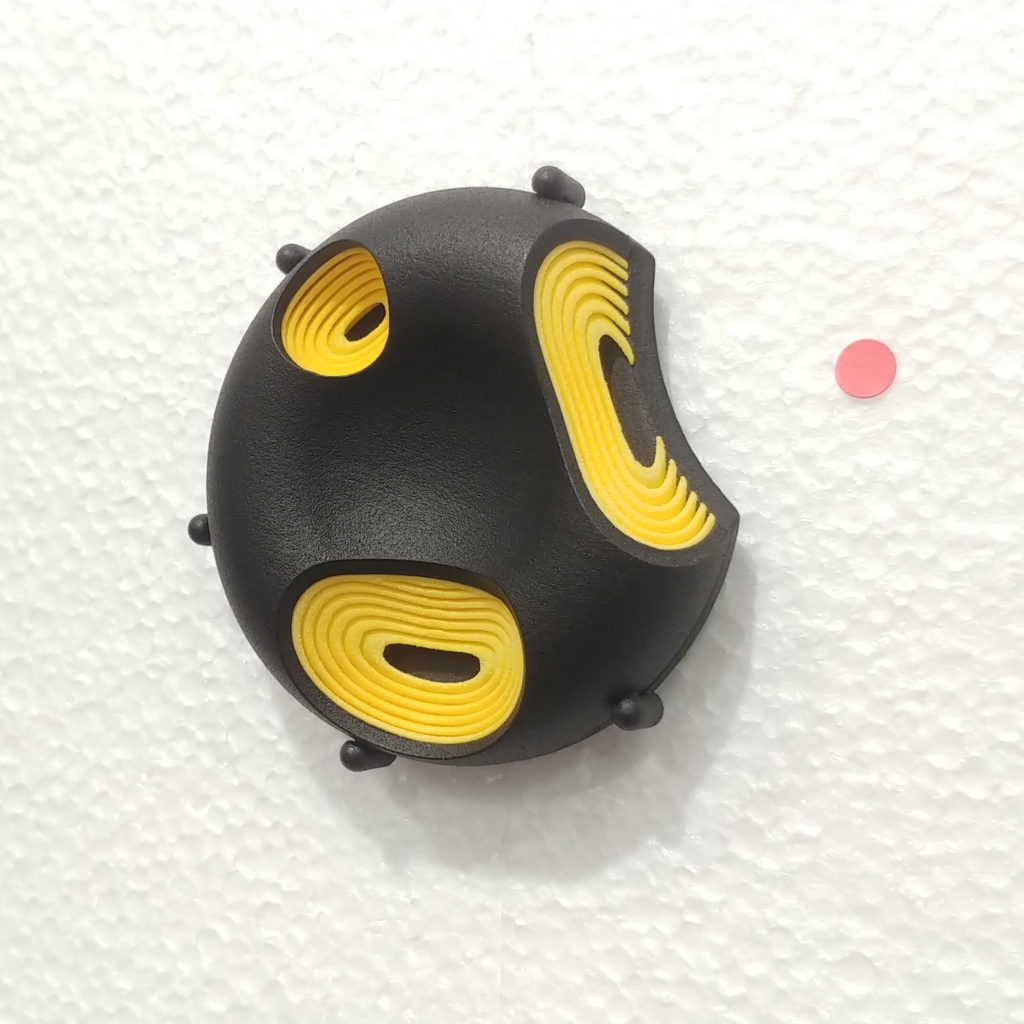
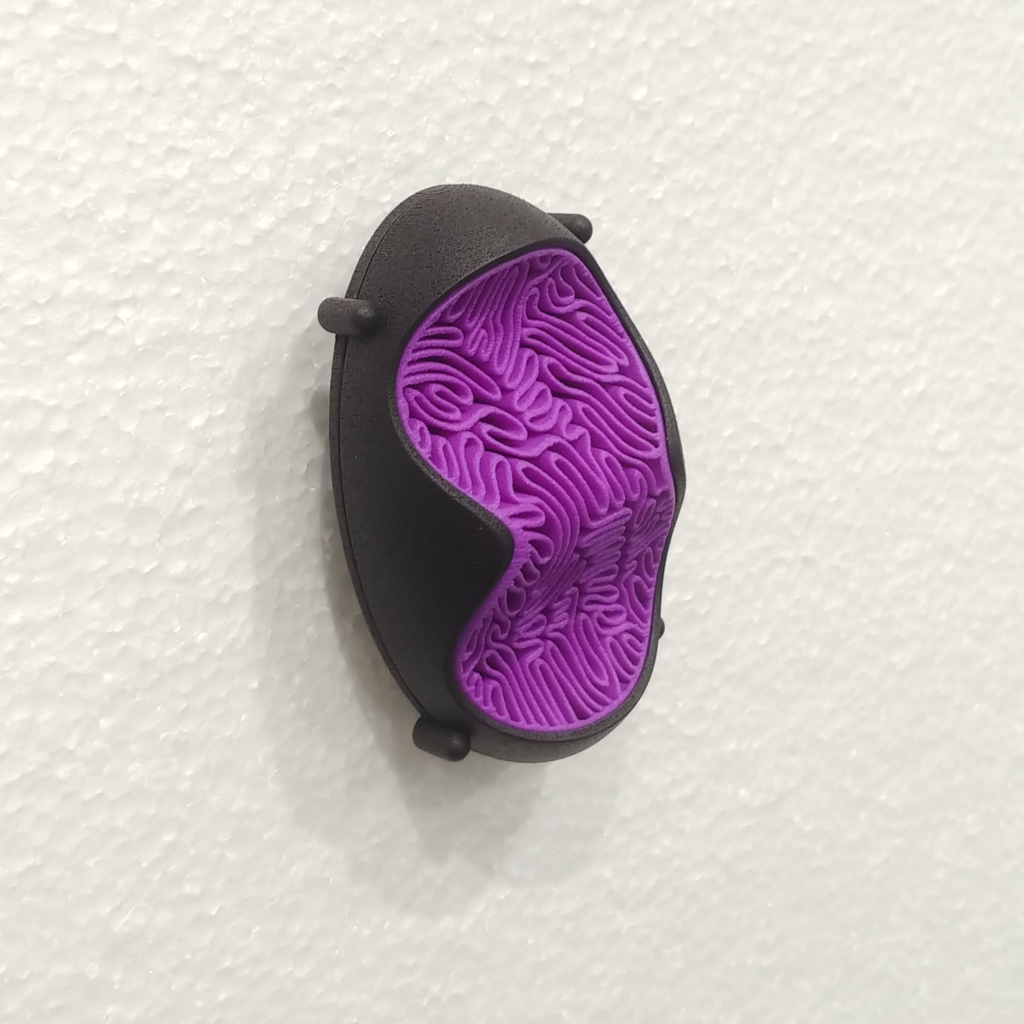
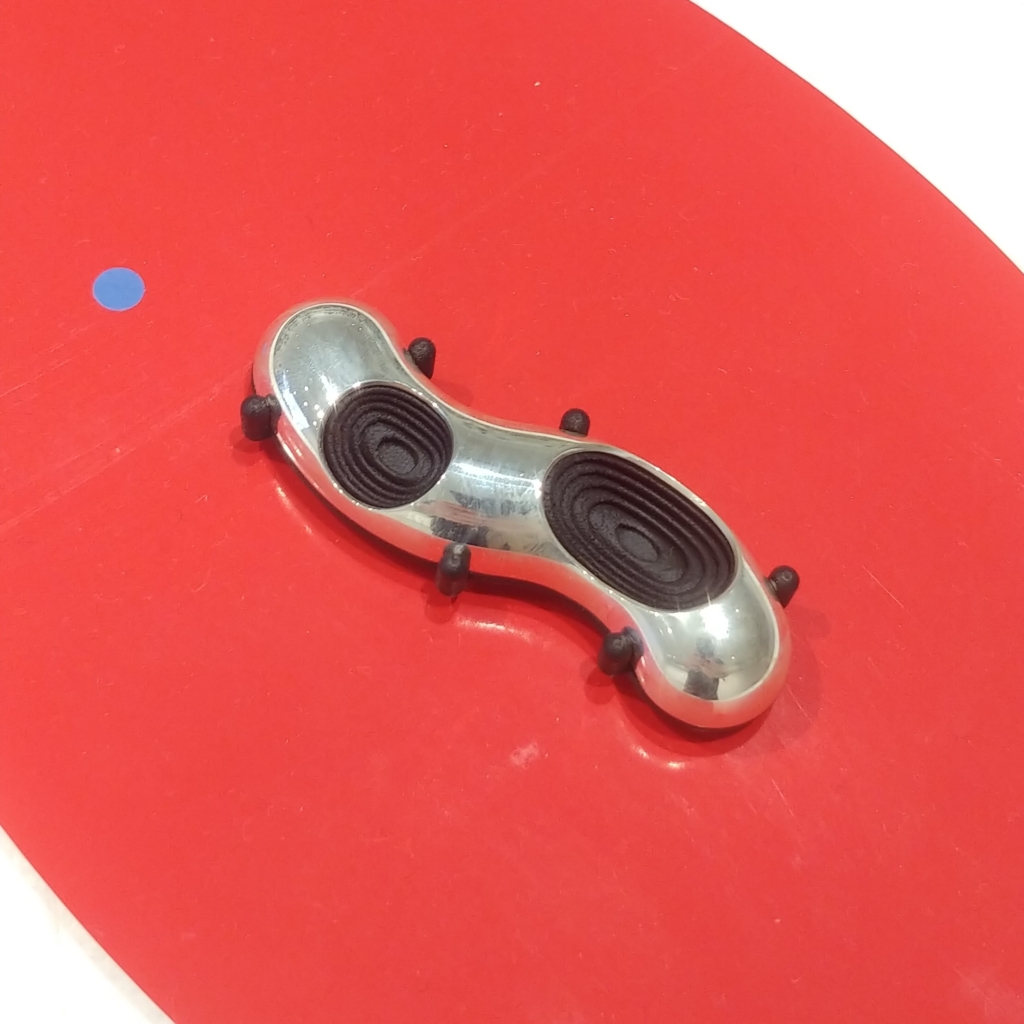
‘Slice’ is a collection of jewellery expressing my fascination with the microscopic realm of the human body. Abstract forms refer to bacteria, viruses, cells and their structures within us. As these invisible but universal components come to define us, they also acquire cultural meaning independent of their biological definition. The highly aestheticized microscopic imagery and cutaway diagrams from popular science are particular sources of inspiration for this work: geometric forms, graphic patterns and vibrant colours. The forms are “digitally handmade” using a combination of computer modelling and 3D printing technologies with traditional metalworking techniques of forming, fabricating and finishing. Slicing through these forms reveals surprising and pleasing sections and patterns. However, the slice, like a microbe itself, exposes tensions between the benevolent and sinister, the beautiful and ugly, the fascinating and fearful.
– Paul McClure
All the work is made using a mix of 3-D printing and hand fabrication skills. It is colourful and intricate, but also slightly unnerving.
Understanding the differences between estate, antique and vintage jewelry can be confusing because the terms can often be used loosely or incorrectly. But, to keep everyone on the same page, there are some more concrete definitions that have been established to help distinguish between the three.
Most of the distinction between estate, antique, and vintage jewelry comes from the age of the piece and whether it has been previously owned.
Find out what determines whether a piece is classified as estate, antique, or vintage:
Estate Jewelry
A lot of people think of estate jewelery as a piece that has been passed down for generations. But to be more clear, estate jewelry is essentially any piece that has been previous owned, regardless of its age.
Because estate jewelry has been previously owned, the jewelry has had time to age in some capacity. It’s rare that a piece is sold for estate immediately after it is bought. And because this jewelry has usually been around for at least a few years, most estate jewelry can be categorized as either vintage or antique.
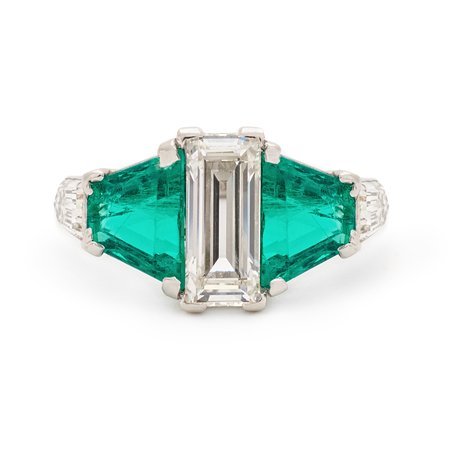
Ring, Emeralds and diamonds
Antique Jewelry
Very simply, antique jewelry is any piece that is over 100 years old. These pieces are often very rare and precious and typically have a lot of history associated with them because of their age.
Antique jewelry is often characterized by which decade it came from. The Georgian Era (1714-1837) has pieces that are handmade. This jewelry predates the Industrial Revolution, and very few of these delicate pieces survived. Georgian jewelry is very rare and valuable and often has nature details and precious stones.
Then there were the Victorian years. The Early Victorian Romantic Era (1837-1850) features nature-inspired designs which were delicately and intricately created in silver and gold. Lockets and brooches were popular along with colored gemstones and diamonds. During the Middle Victorian Grand Era (1860-1880), much of the jewelry became dark and less colorful. The Late Victorian Aesthetic Era (1885-1990) was characterized by star and crescent designs plus renaissance revival lockets set with seed pearls of flowers, hearts, and animals.
The Arts and Crafts Era (1894-1923) consisted of simplified, handmade jewelry which was a rebellion against the styles developed by machine during the Industrial Revolution. This jewelry did not have excessive decoration, and the construction was often visible, featuring hammered metals and handcrafted techniques.
Jewelry of the Art Nouveau Era (1895-1915) revitalized the jeweler’s art, with nature as the principal source of inspiration. These pieces were complemented by new levels of technique in enameling and the introduction of new materials, such as opals and semi-precious stones.
The Edwardian Era (1901-1915), named after Queen Victoria’s son Edward, was characterized by extravagant jewelry with the reintroduction of expensive diamonds, rubies and emeralds arranged in complex designs.
Art Deco (1915-1935) jewelry evolved from relatively delicate designs to more geometric and angular patterns. Stones were cut in strict, geometrical shapes.
Brooch with pearls and aquamarine
Vintage Jewelry
Vintage jewelry is any piece that is less than 100 years old, but is generally greater than 50 years old. The second half of that definition is loose based on which jewelry professional you ask.
After the 1920’s, there were a few different eras of vintage jewelry. In the early part of the Retro Modern Era (1945-1960), Hollywood-inspired pieces were colorful, bold and flamboyant, including large cocktail rings, bracelets, necklaces, pins, and charm bracelets. Gold became the metal of choice because platinum was not available to the jewelry industry during WWII.
You could also find Jacqueline Kennedy inspired 60’s jewelry and dramatic and gold jewelry of the 80’s that is considered vintage.
And the fun thing about buying vintage jewelry sometimes is that, with a quality piece, after 100 years of age it could turn into an antique piece while you still own it!
Diamond Ring
Come to see us, at Jewel Envy, with any of your estate, vintage or maybe antique pieces, we can repair, clean, resize or make a change to one of your unique and lovely pieces.