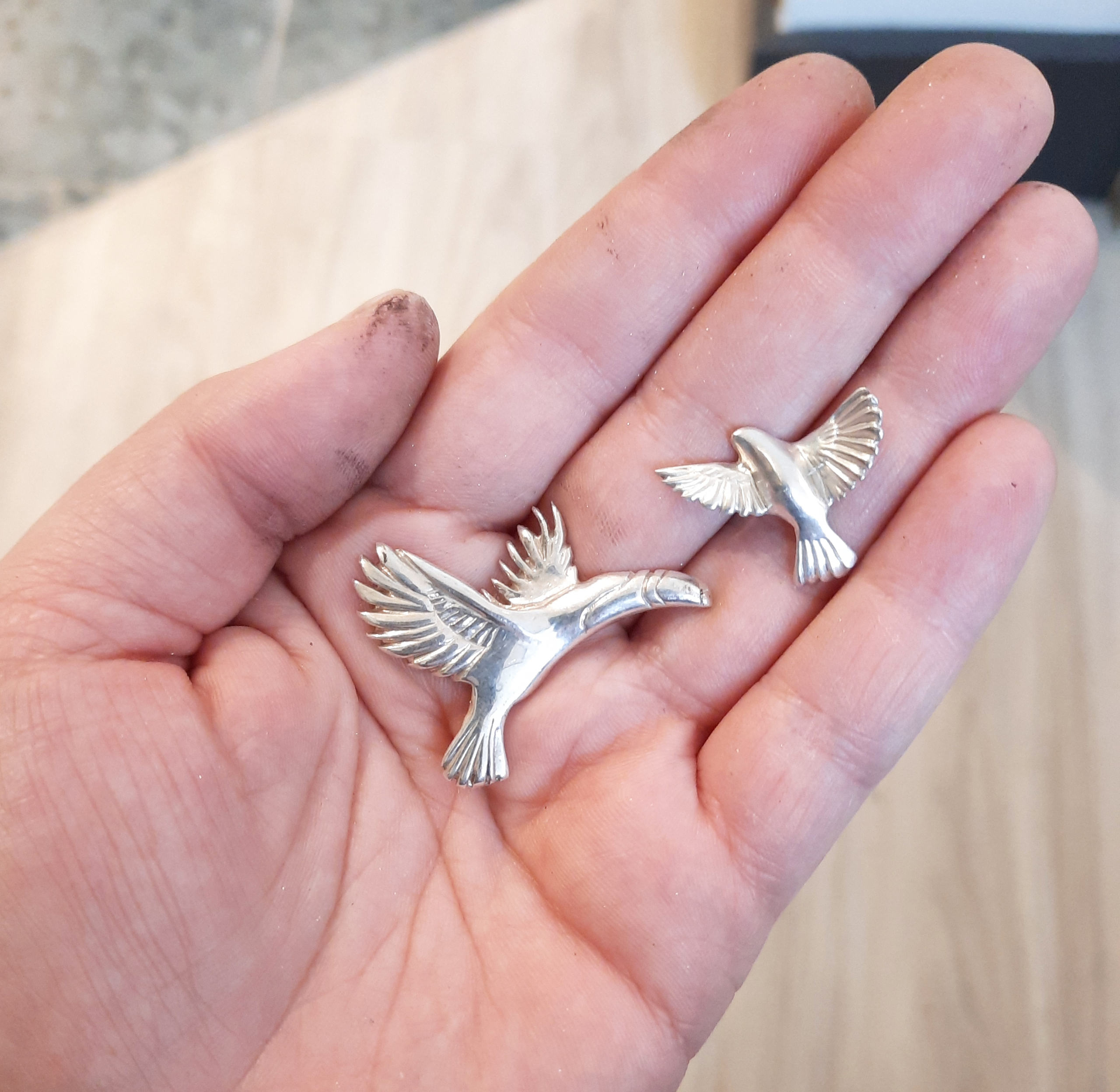
Here’s a little peak at something I’ve been working on.
This gives you an idea of the processes involved when turning a beach find into a precious metal wearable object via the lost wax casting method, which is a method of casting that has been used for millennia. It’s like a delicious thread connecting us back to the ancient Egyptians, Sumerians, and beyond.
I found this wonderful little shell on my last trip to Nova Scotia, which inevitably involves a wander on a beach at some point every day, or I haven’t done it right.
Unfortunately I didn’t take a photo of it before making the silicon mold *slap on the hand* , but you get the idea…
Once you make a silicon mold, you have to cut through the whole thing with a sharp blade, which, if it is delicate, usually means the object gets destroyed in the process. More often than not, so do parts of your fingers.
wax multiples
silicon mold
Once you have multiples in wax, you make a WAX TREE! You set this wax tree in a steel flask, mix up a special plaster, pour that carefully over your wax tree, and VOILA, you have a plaster mold.
That plaster mold is left to cure overnight, and once it’s cured the wax positives are melted out in what’s called a BURNOUT (that’s the professional term). Then the plaster mold is placed in a kiln and brought up to about 900 degrees F, so the molten metal doesn’t get “shocked”, or contract because of the temperature difference, and ruin your cast in one foul swoop.
Once the mold is hot enough, the flask/mold is fitted into place on the casting arm in the centrifugal casting machine, while the metal grain is being heated in the crucible. Once the metal is molten (for silver we’re talking about 1700 degrees F), the lock is released and the metal is shot into the mold as the casting arm spins away, and you send a prayer to the Divine Ones for a successful cast (but really it’s the culmination of all that damn fine effort and care you put into it, step by step, to get to this point).
When the flask/mold has cooled enough so the silver is no longer a hot red, it gets quenched in a bucket of water, and the plaster just FALLS AWAY – like magic! After a quick clean, this is what you have.
After a quick dip in a sweet sweet acid bath, baby girl gets to sparkling and shining.
A snip here, a *kiss* of a file there, maybe a brush with a hot flame, and what you have is something close to a pendant, and a few more decisions, like what stones am I going to set in those barnacles, and should they SPARKLE or just wink?
I am avoiding doing some emerying and since I’ve already done the studio cleaning, gonna do some blogging! Wanted to share some recent camera roll pics (maybe mostly to show off my eye shadow game) to try and sneak in some interesting links. – Alexis
My silver hairs seem to be reproducing exponentially lately… although gotta say love that I’m am growing a badass streak!Been thinking about, sketching, and fussing about with some new spinels. Found this progress shot before combining my Tuca and Bertie into a necklace. I have been very exacting about chain placement; it is still waiting to be finished.When you test drive a new pair of earrings by Alex Kinsley then get to keep them. Makes deciding on shadow colours easier ;o)Something that is actually finished!! Ruby Ironwork earrings. I had some process pics of recent custom pieces, but because they are on their way to customers I want to wait to show them off!
Another Saturday, another musing from me! I think I’ve mentioned this before, but sometimes I have ideas that roll around my brain for years. Lately I’ve been thinking about Chatelaines. What’s that, you say? A chatelaine was traditionally a way to cart around everyday useful items, like keys, scissors, etc. without weighing down a pocket. They could be quite decorative, and they were usually attached to a pocket or a belt. They were worn by both men and women, but I most often think of them worn by women, as they were frequently worn by the woman of the house, or a housekeeper. You can read a bit more about them here.
My fascination with them began a number of years ago, when I saw this one:
I love the intricate details, it was amazing to view in person.
In fact, it’s been so long that I had to look it up to figure out if it was from the Victoria and Albert Museum (UK) or one of the other UK museums I’ve visited many times. It was the Victoria and Albert. In fact, you can view many other examples from their archive here
So, I’ve been thinking about what a more modern chatelaine might carry. Not surprisingly, probably not that many differences to what you can see in historical examples for everyday use. How about as a goldsmith? That’s a bit of an interesting question… for me, maybe a notebook and pencil (for when inspiration strikes), keys, a scribe (a kind of pen for metal), small files, scissors, tweezers, all things that are handy for a goldsmith, but still all kind of pedestrian really.
No, what I’ve really been thinking about is what the modern immunologist’s chatelaine would look like, which is more conceptual really (and fits in with my background and some of my interests). So, scissors (what aren’t those useful for???), but my scissors might be molecular scissors, T cells, B cells and macrophages would be a must, antibodies and plasmids are always useful too! Not sure what else, I shall have to think some more.
Yes, my skills at doodling are nothing to write home about, but anyway, here’s a quick impression of what MY chatelaine might look like in my brain!
If you were making your own chatelaine, what would you put on it?
I am not sure about whether or not this year’s Toronto Outdoor Art Fair will actually be outdoors and in person, but I am still excited to be applying to it this year in the hopes that I can be interacting with people (I may or may not have to practice first though). If the Art Fair is not an in person event they will once again be holding the Fair online and be featuring artists on their site starting July 2, 2021. You can check out my 2020 Gallery.
Just below are a few of the images that I applied with for this year’s upcoming Fair. Wish me luck on my application and I will be updating info about the fair starting in the spring.
Garden Quartz Ironwork Pendants. Sterling silver and garden quartz.Rose Ring. Sterling silver and 14 kt rose gold.
I am still trying to navigate shifting my sales and connecting with people online and last years Toronto Outdoor (Online) Art Fair had me setting up for online sales for the first time (outside of trying Etsy just before 2010). I am struggling to try and make that connection as building my confidence for in person sales took several years of customer interactions to learn from and making the shift to online is a social skill that I frankly do not have. I am always striving to make a connection and I suppose that online sales feels very much to me like standing on a corner talking to yourself about your business in hopes that someone is within earshot (or is this just me?) I am definitely overthinking this at the moment and just need to push past this feeling and remind you that if you have read this far let us know what you miss about seeing us in the studio – Alexis
I really enjoy teaching, it’s great to share knowledge, and to see how excited people get when they’re making things, and that spark and drive to carry on. There are lots of different aspects that I enjoy, but I really like the thought that I’ve facilitated development of skills that will carry a student into the future, and nurtured their creativity/passion. I used to apply this to my students as a research biologist, and when I changed careers to focus more on my goldsmithing, one of things I looked forward to doing was to carry on teaching.
As you may know, we teach workshops and classes at the Jewel Envy studio. One of my goals for last year was to start teaching…..in March….. so you can guess what happened! I managed to get in a small workshop as part of the Stakt market Christmas events in December 2019, where we did these fun bookmarks. There was lots of hammering fun!
So, back to March 2020, and everything was closed, so I was denied! Then things started to open up again and I got my chance to experience my first eight week Intro to Fabrication class, with a smaller class size, masks all around (well, we actually wear them quite a bit anyway), and all the other safe measures we could take. We managed to get the classes in before things shut down again, and we managed to get the students through the basics, and still have fun. They made some awesome pieces, with lots of variety within the set of beginner skills that we teach them. Here’s a collage of some of the projects the students completed:
Sadly, we’re still unable to start up the classes we were hoping to start running again, but we’re all prepared to sail ahead when it’s safe to do so again. If you’re interested in any specific classes, make sure you’re signed up to our newsletter, or send us an email to say what course you’re specifically interested in!
Stay safe, and we hope and look forward to welcoming you back to classes in the not-so-distant future!
What does trying to continue running a business while following stay at home directives means for the goldsmiths working at Jewel Envy? Because we cannot work from home we are continuing work in the studio on custom projects, repairs, and redesigns. Not being able to have walk-ins to meet with customers in person means the onus for getting custom jewellery made has shifted largely onto the customer and I encourage anyone interested in a custom piece to browse the goldsmith galleries, our instagram, and websites. We like to remind people that you may not see the exact piece you are looking for; we want you to choose someone whose work speaks to you whether is because of their style, the materials they like to work with, or the techniques they like to use. We’re staying on top of emails so any and all questions can still be sent our way and we can start a discussion on the best course of action for starting on a custom jewellery quest! – Alexis
Custom Larimar bracelet. After arranging a drop off for the rough larimar Alexis Kostuk of glaciale goldsmith created sketches and quotes that were sent over email. After having finished we arranged a porch pick up and the customer is excited to have her new custom bracelet to wear!
We’re now well into December, and the hunt is on for that perfect holiday gift. I love giving thoughtful (and often handmade) presents (regardless of the occasion!). Not much making is happening for me this year, though. Instead, I’ve been virtually shopping at various local places to find my gifts, as well as wandering the neighbourhood to find new places to check out online. Which in some ways has been a lot of fun—I’ve found a lot of small places that I didn’t know about, that are kind of cool!
Although I think it’s no one’s favourite way to shop for everything, there is something to be said for shopping from your couch still in your pj’s! Remember, there are lots of ways to support small, local business this season: shop online from a local small business, leave a review or make recommendations to people you know. They all help, both in the short and long-term.
I’d love to share some of my purchases with you, but as they have yet to be gifted, I think I’ll have to keep them to myself!
Good luck with your holiday shopping, and remember, we have a newly updated online shop
You can also contact the studio for a virtual shopping meeting, or arrange a porch trip (or a combination of both!) to help you in your quest to find that amazing gift you’ve been looking for.
However you choose to shop, find the fun in doing it, and have a great day!
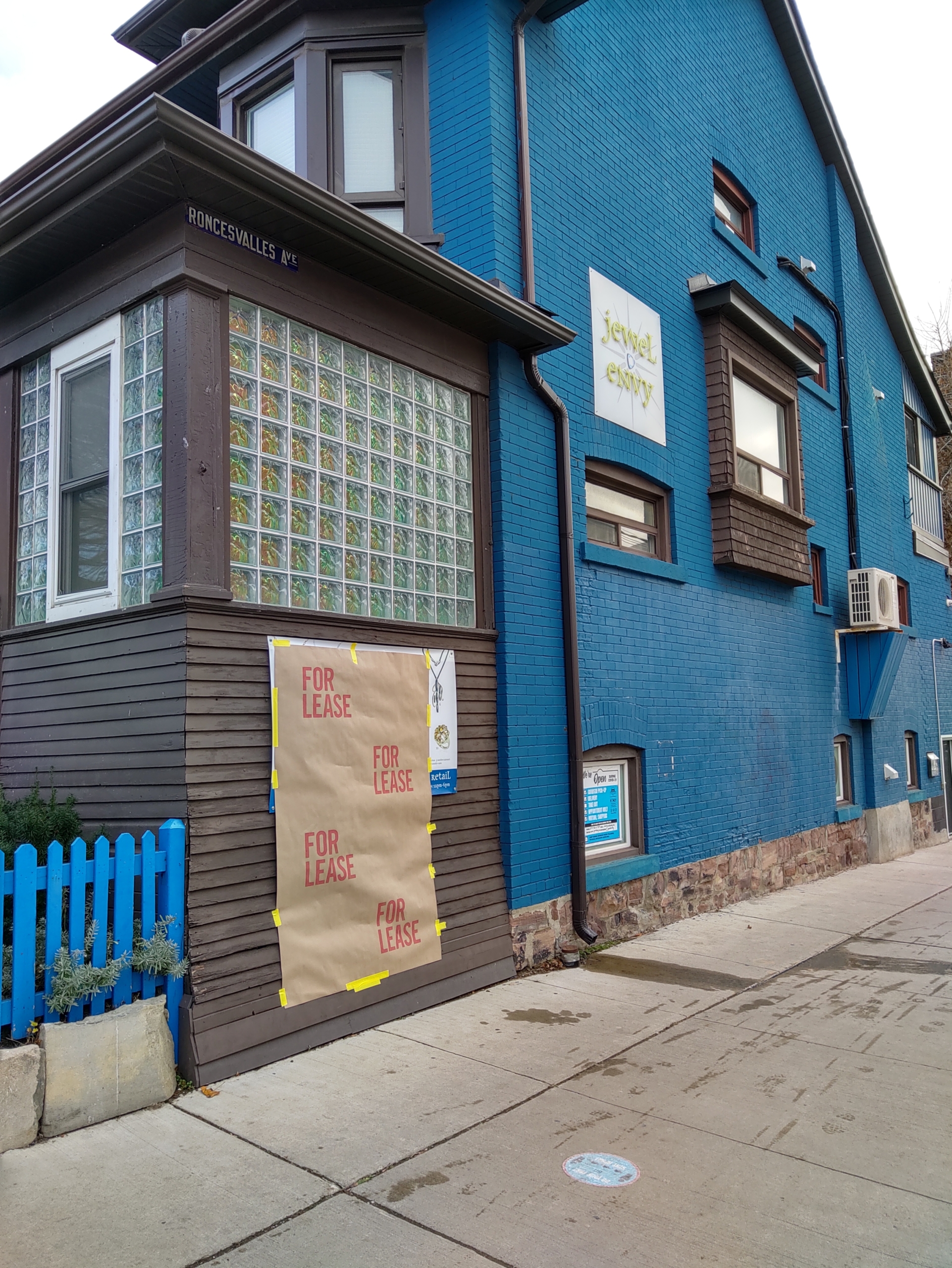
The view on Roncy was bleak the morning of Tuesday November 23rd, 2020 as the neighborhood woke up to see the message of “For Lease” kraft paper plastered on many of the businesses. This was done to shake people out of complacency, grab their attention and make them see what might happen come January 2021. These stores (including my own) are not for lease….but they could be without the support of the community and our customers who choose to think big but shop small. The pandemic has changed every part of our lives but consumers need to take a look around and realize without their support the places and businesses that make a neighborhood vibrant and livable might not survive another lock down and this is not just our neighborhood but a global issue.
The Not For Lease Campaign was the result of not just a main-street or the marketing company we worked with (The Local Collective) but a whole community banding together to say too much has happened this year, we have come to far, this is what we are scared of. We need everyone to see the message loud and clear that all of our local businesses need your support this season!
After the initial shock of the “For Lease” Kraft paper campaign, to make businesses look closed, the paper was removed the same day and replaced with messages of love, hope, and strength! This is part 2 of the campaign reminding people local support and care will help all of us through the set troubling times! Jewel Envy is still doing custom work/repairs/virtual shopping for curb pick up or shipping and we even have an online shop.
The message has been received loud and clear across our community, Canada, and we have heard it even made it into international news relating to COVID 19 and the plight of the small business throughout the world.
Jewel Envy supports the need for the lock down at this time. We hope all of you will remember to support the many businesses in need who are abiding by all public health and safety requirements for the greater good, which is having the unfortunate effect of jeopardizing their future sustainability.
November, the middle month of post-Halloween sugar rushes and the anticipation of Christmas jitters. Traditionally, November has been associated with the golden gemstones of topaz and citrine. This blog will be about the prior, topaz, as I feel too many November babies complain about this gem. Lucky for you I know many things about this gemstone, including the many colours it can be when the conditions are right.
There even are varieties of topaz that deserve enough respect to be labelled as “Imperial”. Aside from the known golden orange colours, topaz can come in colours of wine red, pink, yellow, grey, colourless, blue and even a rare green and violet. Topaz is also an interesting stone as it’s colours can be enhanced with treatments, more so than other stones.
Range of color in Imperial topaz rough from Oro Preto, Brazil.Imperial topaz rough from Oro Preto, Brazil.
Topaz is a very old gemstone but has a muddled history as the name was used to classify any yellow gemstone, hence it gets mixed up with citrine. Etymologically, the name derives from the same island that peridot was mined in ancient times, Τοπαζος, the ancient name of St. John’s Island in the Red Sea. The word topaz may also be related to the Sanskrit word तपस् “tapas,” meaning “heat” or “fire” due to the burning red and gold colours some of these gemstones display. In the modern era, topazes are fairly abundant compared to their cardinal cousins. Many of the rare and beautiful varieties of topaz come from Brazil, however, the USA, Sri Lanka and Africa are also known to supply excellent examples of this gemstone as well.
Photographed from the GIA Collection for the CIBJO project from the Dr. Eduard J. Gubelin Collection. Left to right: Collection# 33572, 14.33 ct golden orange cushion cut topaz from Ouro Preto; # 33552, 14.32 ct rose red cushion cut topaz from Ural Mountains, Russia; Collection# 33581, 7.61 ct rose red fancy cut topaz from Russia; and Collection# 33575, 12.54 ct orange red baguette cut topaz from Ouro Preto.
There are many attractive traits to topaz besides its colour. With a hardness of 8, it produces a bright lustre and is fairly resistant to scratches, however, chipping is a different story. Due to the atomic alignment, the crystal structure has weak points, known as cleavage planes. In topaz, these cleavage planes are very pronounced, as in it makes a clean break, and the stone can easily fracture along this plane. To avoid this, gem cutters cut the gemstone off angled to these planes to minimize the risk of cleaving your stone. Gem cutters also love this stone because it is relatively flawless compared to other stones thus you are able to cut beautiful flawless gems.
Using a child to scale just how big these flawless crystals can grow.
Another intriguing quality about topaz is its strong pleochroism, an optical quality in a gemstone that allows the stone to show different colours depending on what angle you look at it. All transparent matter refracts light as the wavelengths are slowed down when travelling through a thicker medium. When there is a distinct crystal structure, these wavelengths are split into the slow and fast ray. If it’s a large enough split, different colours distinguishable to the human eye will be expressed. For most topaz, these colours are just deeper or light versions of the body colour. However, in some stones the stone will appear pinkish from one viewpoint and orange from another, giving it a real fiery dance of colour.
How pleochroism works and how we are able to detect it with a polarized filter. This characteristic helps up identify gemstones from one another. Excellent example of pleochroism in the mineral cordiorite or iolite for the gemstone name. This stone will appear either straw yellow, deep blue or grey-violet depending on the angle you look at it. All of this is related to the atomic structure and crystal axis of the mineral
Alright, now to dive into the source of these colours and how to detect your topaz is a true topaz. As topaz is relatively abundant, there are not synthetic varieties to worry about. Treatments and imitations are a different story. There are several varieties of topaz, such as the blue ones that cannot be easily made by nature. This is the case with deep blue topazes, properly named Swiss and London blue. The lighter blue usually referred to as “Sky Blue” can appear natural or be created through treating a clear stone. Now here is what is really cool about these coloured topazes. The colour is created through radiation. The process involves pelting the stone with gamma rays (this deforms the crystal lattice) turning the stone to a brown colour. Then they heat the stones to 250℃ to produce a deep, beautiful, stable blue. Unfortunately, there is no easy way to detect this treatment so it has been agreed upon that unless indicated with evidence, all blue topazes have been treated. Still, I find it hilarious thinking about the mad scientist who discovered this treatment.
A raw natural Blue topaz crystal
While clean and grey topaz can be transformed into a captivating blue, yellow-brown stones can be heat treated and transformed into a pink topaz. Interestingly, this is only true if there is chromium within the crystal, otherwise, the treatment turns the topaz colourless. Interestingly they have discovered that the magic temperature is 550℃ to optimal pink. The stone first goes clean and then as it cools the pink starts to shine through. Higher temperatures cause the stone to remain colourless as it cools. Many ‘Imperial” topazes are treated with this treatment to help emphasize the pink tones within the stone. Again it is hard to distinguish the difference between natural and treated stones. Unless indicated, treat all of these stones as treated as well. Gold, brown, orange topaz are less suspicious as they’re the less desired colours.
How treatments change the stone.
The only known imitation stone I know used to imitate topaz in cubic zirconia. They can be easily distinguished from topaz as they lack pleochroism and have a much brighter sparkle. Instead, it’s topaz that is used as the imitator. Little fun fact but if you freeze a topaz, it will pass as a diamond with a thermal conductor tester used for diamonds. Thus colourless topaz has been used to imitate diamonds since there is no pleochroism. They also share very similar blue hues and have been mixed up but topaz is easy to tell from diamond again due to the pleochroism. Other stones that are mistaken for topaz are citrines and lighter garnet colours.
One topaz I want to really make sure you watch out for is the topaz known as Mystic topaz. This is a beautiful stone but the colours are not from the stone. This polychromatic effect is created from baking a titanium oxide coating onto the crystal and then anodizing that oxide. This coating is applied to the pavilion or underside of the crystal to protect the coating from wear. The issue I have with this stone is that I have seen it dubbed many names, such as Caribbean Topaz, Azotic Topaz, Rainbow Topaz and more. It’s a very beautiful and colourful stone but not natural. Also, beware the misnomers, topaz is a common name used for less expensive citrines and smoky quartz
Mystic Topaz.
Now as I have always stated, there are always unique outliers and that if you are ever curious about your stones, bring them to a certified gemmologist. They know best and can tell you if you have a topaz or not and MAYBE if it’s treated. Again most are assumed to be treated unless specified. Otherwise, if you want a relatively inexpensive but equally beautiful stone that can stand up to everyday wear, then the November birthstone might catch your eye.
I have attached a few links for you to look through at your leisure if you are interested in learning more about opals and their patterns.
If you are looking to support local you an still shop with us! We have items available in our recently expanded online shop and we would love to do a virtual shop to help you select something in the store that we can arrange for curbside pick up.
I selected a piece from online or one that is available in store (available for curbside pick up) from each of our goldsmiths. If you would like to explore more in store options get in touch over email or call to set up a video call to check out more options!
Available online Alexis Kostuk’s small hoopsTurquoise Necklace by Alexis Kostuk of glaciale goldsmith. In store, available by getting in touch info@jewelenvy.ca or 647.436.6709
Available online, Textured Kinetic Earrings by Robin Cassady-Cain.Cufflinks by Robin Cassady-Cain of House of Cassady. In store, available by getting in touch info@jewelenvy.ca or 647.436.6709
Available online, Lollipop Brooches by Alessandra Pompei.Oval Signet Ring by Alessandra Pompei of Pompei Fine Jewellery. Available online and in store. Other shapes (heart, rectangle, square) in store available by getting in touch info@jewelenvy.ca or 647.436.6709