Sapphire, the royal blue gemstone with more than one shade of blue.

Natural sapphire crystal.

September, the beginning of the BEST season, autumn. I mean every season has its perks, this summer especially was wonderful with the heat, but fall still is the best. The colour, cool nights, no bugs, scarfs, sweaters, crunching leaves and the smell pumpkin spice coffee in the air. While October is the better of the two, the birthstone for September is better, in my biased opinion. Sapphires, the bluest of the blue gemstones, are more than just blue. Now just to clarify this before we continue, as I stated in the blog about rubies, corundum is naturally colourless, and thus colour comes from impurities within the stone. Sapphire is the blue variety and padparadscha is the pink/orange variety. All other colours are classified as “fancy sapphire”, this is odd as the beryl varieties had unique names but when it comes to corundum in the yellow, violet or green hues then they are referred to as a “yellow sapphire”, “green sapphire” and “violet sapphire”. Confusing, I know, even to a gemmologist. Unless a colour is in front of the word “sapphire” then it is assumed one is referring to the blue variety of corundum. 

The many colours of corundum.
Photographed for the CIBJO project from the Dr. Eduard J. Gubelin Collection.

Sapphires, like some of the precious birthstones, are as old as time itself. Traditionally, the sapphire symbolizes many things, from wisdom, nobility, truth, sincerity, and faithfulness as well as awareness and the “heavens”; blue has always been a symbol of something special to us humans. While there is no real set date we have for when we discovered these stones, the name derives from ancient Hebrew, סַפִּיר (sappir). Some linguists propose that the semitic (e.g. Hebrew) terms derive from Sanskrit Sanipriya (शनिप्रिय), from “sani” (शनि) meaning “Saturn” and “priyah” (प्रिय), dear, i.e. literally “sacred to Saturn”. Other translations from Greek and Latin sapphirus, and Greek σαπφειρος (sappheiros) mean “blue” or “blue stone”.  

Beautiful examples of when colours collide within sapphire. These are some examples of bi-colours sapphires. Montana has a number of yellow, blue and green bi to tri-coloured varieties.

Sapphires originate from many locations. The prized location, which has now unfortunately been mined out and in the midst of a horrible border dispute, is the Kashmire sapphires of the Himalayans, these sapphires are like the designer name brand for sapphires. These sapphires are renowned for their colour intensity and rich blue. Other locations include Australia, Myanmar, Sri Lanka (home of Ceylon Sapphires), Madagascar, Montana in the USA and recent discovery in Nunavut, Canada.   

Rough and cut Kashmire sapphires.

Sapphire is identified as:

  • 1) Trigonal Crystal System, not to be confused with crystal habit. (Note, habit is how the mineral crystallizes)
  • 2) Oxide Composition, 
  • 3) Simple Oxide Family
  • 4) Mineral = Corundum – Al2O3
  • 5) Variety = Sapphire.   

Now for the fun part, how is sapphire blue? This is an interesting question as sapphires change the game a little when it comes to colouring. Unlike ruby where it gets its colour from traces of chromium within the crystal structure, sapphire blue colour comes from the interaction of iron (Fe) and titanium (Ti) with aluminum in the crystal structure. I emphasize the use of interaction here as the iron and titanium don’t just replace aluminum in the crystal structure like chromium. Fe and Ti actually play with valence electrons in the crystal to cause a “colour trap”  us to see blue. In simple terms, Fe and Ti cause small kinks or traps in the atomic structure of corundum that affects the valence electrons of the surrounding aluminum atoms. Light entering the sapphire excites the valence electrons causing them to jump/pass through the trap. As they do they absorb energy, the same wavelength as yellow light from the photons. The result, we see blue as the yellow and some greens are removed from the visible spectrum. In a weird way, sapphires are blue not because something is there, but because of a void, and without light they would actually appear colourless. 

The many shades of sapphire blue.

Now, let’s get serious about sapphires.  With the high price of sapphires, there are many treatments, synthetics and imitations to watch out for when hunting for sapphires. First, some terminology needs to be explained, mainly the terms “natural”, “synthetic”, “imitation” and “treatment”. A natural gemstone refers to a stone made from the earth and is what most people desire/expect. A synthetic gemstone is an identical copy of a natural, just made by man. This means it has the same chemical formula and crystal structure as its natural counterpart. Ideally, the term “synthetic” should only be used if the man-made stone has a natural counterpart. If there is no counterpart, then this stone is referred to as an “imitation”. Imitation is a stone or material representing another stone. Imitations can be natural or synthetic and confuse many people. Cubic zirconia is one of the most common samples for imitating precious stones. Treatment or a treated stone is a natural stone that has been tampered by humans to improve colour saturation, clarity, and durability. There are many interesting ways we have discovered to help improve the natural beauty of precious stones. 

For sapphires, the most common treatment you will see is heating and or surface diffusion. Heat treatment is as the name suggests. The sapphires are slowly heated up to a temperature of from range 800 °C to 1800 °C in an oxygen-free environment, depending on the stone and desired outcome. These stones are then held at this temperature for a few hours or sometimes a few days. Interestingly if the sapphire is heated in an oxygen environment then the colour can lighten, this helps brighten darker, inky blue sapphires, or eliminate blue tones from purplish rubies. The heat actually reduces the iron in the crystal from Fe2O3 to FeO. This transfer increases the presence of the colour trap I explained above, thus a richer, deeper blue colour. This process even works with the other coloured sapphires, like with yellow sapphires. Now these are general temperatures, exact temperatures, times and gases used are a well-guarded trade secret, take it from me I’ve tried searching for some formulas. 

Heat treated sapphires before and after.

Heat treatment can also help increase the clarity of a sapphire. Iron and titanium are also the same elements needed for rutile, the mineral responsible for asterism within sapphires; these silk-like fibrous minerals are what cause the “star” in star sapphires. Sometimes this works in favour of beautiful stone, other times it doesn’t. Heating can help diffuse the rutile threads, dissolving them into the sapphire. This is the case for Geuda sapphires, milky light sapphires from Sri Lanka.  Interestingly if there is no iron or titanium at all then this treatment renders useless. When that happens, another treatment is available.   

An example of a man at work, traditional heat treatment for sapphires are still precticed today in Sri Lanka.

The other treatment I mentioned is surface diffusion treatment. This treatment is similar to the heat treatment, using temperatures around 1750 °C and coating the sapphire with iron and titanium oxide. These stones are then left in this environment for several days. The idea here is to heat the stone so hot that the surrounding ion and titanium begin to diffuse into the surface of the stone. This treatment just enhances the surface colour, not the internal colour. This process unfortunately causes pitting in the surface of the stone and you need to repolish the sapphire. 

This diffusion-treated blue synthetic sapphire shows the shallow depth
of the treatment, confined to a surface layer. Bottom: Diffusion treatment is evident in the
colour concentrations along the girdle and facet junctions. From Robert E. Kane et al.,
“The Identification of Blue Diffusion-Treated Sapphires,” Summer 1990 Gems & Gemology;
photos by Shane F. McClure.Surface diffusion sapphires showing how the colour has been enhanced.

Now for the best part, how can one tell if their sapphire was treated, synthetic, imitation or natural blue wonder? Well, the most obvious answer is to get a professional to look at it. Second, like with all gemstones look at the cost. If the price is too good to be true then it probably is. Sometimes traders don’t know their material and this can work in your favour or against you, buyer beware. If you have a loupe or a strong magnifying glass there are a few things you can look for in your sapphire. For heat-treated sapphires, look and see if there is colour banding. This colour banding is a crucial feature of sapphires. You will see hexagonal or straight bands of blue in natural sapphire. The more defined the banding the better, heating cases this banding to diffuse and turn fuzzy. If you see inclusions, look around them as heat will cause the minerals in the inclusion to expand at a different rate than the surrounding sapphire resulting in fractures.

If you have a REALLY good eye, or a microscope, look for fluid inclusions. These inclusions are like small liquid-filled cavities within the crystal. They are a result of crystallization but they can have three phases within them, solid, liquid and gas. The solid is salt, you will see a perfect cube sitting in there, the liquid is water and the gas is carbon dioxide. The reason these inclusions are important to gemmologists is they are a definitive sign that not only is your stone natural, but that is also was never treated. To identify the diffusion treatment the easiest way to tell is to immerse the stone in water. Since the treatment is the only surface deep and you have to repolish the facets of the stone, when a sapphire that has been treated this way is immersed in water you will see colour concentrating along the facet edge. It looks like a “web” of blue    

This The photo on the left shows (left to right) a diffusion-treated synthetic sapphire from JTV, a diffusion-treated synthetic sapphire from Gem Resources, a flame-fusion synthetic sapphire from Gem Resources, and a Czochralski synthetic sapphire from Union Carbide Corporation. Right: Viewed in immersion, diffusion-treated blue synthetic sapphires clearly show outlined girdles and facet junctions (top), unlike the as-grown blue stones (bottom). Photos by Jennifer Stone-Sundberg.

Now, what about natural vs synthetic Sapphires. A flawless gem is the most prized gem but also one of the most difficult to identify as inclusions help greatly. When it comes to synthetic stones, you’ll need a microscope or maybe even an X-ray microscope to discern the origin of your sapphire. All gemstones leave clues as to how they formed within the crystal structure and carry trace element signatures. While the chemical signature is the best way to identify a stone’s origin you have to destroy a piece of your stone. I don’t think many people would be interested in having a hole in their great grandmas sapphire to see if it’s natural or synthetic. Thus by using high powered microscopes and polarized light, gemmologists can see signatures as to how gemstones crystallized and your stone is left untouched. Synthetic sapphires are produced the same was as rubies, through the flux-melt method or flame fusion method. These methods should be disclosed when selling synthetic/lab-created sapphires and if not, ask. Since I already told you about flame-fusion corundum, this time I will explain the flux-melt method.   

Colour banding within sapphire. To the left, we have parallel and angled banding in a natural sapphire. To the right, we have the curved striae within a synthetic sapphire created from the flame fusion process.

The most common synthetic sapphire is the flame-fusion sapphire, but there are some produced via the flux-melt method. Identifying them is the same so if you wanna brush up on some gemmology for identifying flame-fusion sapphires, ready July’s blog. Upon revising my notes for this blog I realized I should have discussed the flux-melt method for July as this is the method of choice for rubies. However, the flux-melt method can be used for multiple gemstones. In short, for the flux-melt, you take all the ingredients you need for a gemstone, add a flux to lower the melting temperature (lithium molybdate and lithium vanadate for example), put the mixture in a kiln and bake. It’s that simple, but the actual method and ingredients are a guarded trade secret and can take sometimes WEEKS to produce a gemstone. To identify these stones, look inside. Most flux-melt gemstones will have remains of the flux within the crystal. These will look like liquid metallic blobs within the sapphire. You will also notice a lack of any other inclusions or colour banding. 

Whisp inclusions present in flux-melt sapphire.
Inclusions present in a natural sapphire. The large clear crystals are the mineral zircon and the shinny silky fibres are rutile needles. These are the needles responsible for the asterism star sapphire.

Now if you want to search for your sapphire, just like all the other precious stones out there, it is a buyer-beware world out there. Ask questions, and use your gut first. Also, look at the name. Many stones have the name “sapphire” in them to make you think they are related. Again if it’s synthetic, the process should be indicated with the purchase. Imitation stones will be easier to spot as they will not be as hard or will not show the pleochroism. Common imitations for sapphire include CZ, glass, synthetic blue spinel, blue topaz, blue zircon and sometimes iolite. Again best this is to ask a gemmologist about your sapphires, they have the knowledge and experience with these stones and can tell you if what you have is natural, synthetic, enhanced or an imitation. 

What about star sapphires? Yes, they exist naturally and, like star rudies, are the result of thin mineral hairs of rutile crystallizes alongside the triangular habit/system of the mineral. When these hairs are cut into a dome or cabochon shape along with the rest of the sapphire, the hairs will reflect light like a spool of thread. With three spools come three reflections thus we see a star. This is a phenomenon known as “asterism”, and if there is only one reflection like a slit, it’s known as chatoyancy, or ‘cat’s eye’. Now with sapphires, the rutile hairs and the blue colour are affected by the same element, titanium. It’s a delicate balance when treating a star sapphire as you may get a blue stone but no star or a beautiful star and no blue.      

An exquisit example of a natural star sapphire. You can see the 6-point star created from the fine rutile needles within.

As we go through the months I hope each month you learn something new about your birthstones. There is ample to read about the stones for both lore, mysticism, history, formation and identification. Wikipedia and GIA are great places to start if your curious or I have some books below for you. 

Gemmology by Peter read – A gemmologist bible, make sure to look for the latest addition as there is always new information to be added to textbooks. This book covers ALL the gemstones as well as how to use the tools to identify naturals, synthetics and imitations. Warning this book is very technical. 

Jewels: a secret history by Victoria Finlay – an excellent read into the history and lore behind some of the more renowned gemstones.  

A natural sapphire crystal and it’s beautiful cut counter part.

Well, that was another novel and a half, I hope you enjoyed this blog about the sapphires. In October I will be informing you about either opal or tourmaline I have yet to make up my mind as I have some interesting stories about both. 

Cheers, Peter

Creative process for a Saturday

There’s a definite air of autumn in the air, but it’s terribly sunny. This is really my favourite time of year in Toronto: still warm, but change is happening! This month, I thought I’d share a short story about my creative practice with you.

Like a lot of people, I love art. I never thought I liked much modern art, but then I realised I had a very narrow definition of what that meant, and that it was much larger than I realised (there is alot written about this, one place you can see more information is here).

One artist whose work draws me is Piet Mondrian. I’m not sure I’d say I like his work per se, but I really appreciate the geometric nature and the bright colours of his works. They’ve very distinctive, even if you don’t know his name, you’ve probably seen his work before:

taken from needpix

Part of why I’m drawn to his work is because it really speaks to one of my other crafty pursuits- quilting. I’ve been a member of the Modern Quilt Guild for about seven years. Mondrian’s bold lines and colour blocks really espouse some of the main characteristics of modern quilting.

taken from: wikimedia

This year, with my local group, I decided to participate in the “President’s challenge”. I got two aspects of modern quilting to use however I wanted in any format (minimalism and negative space). I chose a miniquilt, and was inspired to piece a Mondrian-type design, using a charcoal background and matchstick quilting to define the blocks and bring texture to the piece.

I was pretty pleased with how it turned out!

Since I was having so much fun with it, it started making me think about what I would do if I wanted to make a piece of jewellery. My favourite was this minimalist brooch, similar to the aspects of the quilt, made with colour enamel panels, wire and different levels.

Not sure if I’ll actually make it, unless someone expressed interest in it, but I enjoyed thinking about it, and thinking about how to add my own personal twist to it. How about you? What do you do to stay creative?

In any case, I hope you’re all enjoying the autumn weather! Don’t forget to come visit us in the studio-we’re all covid safe, and we love seeing you all again!

Happy Saturday!

-Robin

Peridot, The ancient green gemstone from deep within the Earth and the stars.

Raw peridot in all its glowing glory.

A little late but still at it for the birthstone of the month blog.

August is/was the best month to be out in nature here in Canada. Hot summer days with long setting suns, cool nights and a lack of bugs in some locations make it the perfect time for camping. Peridot, a lime green gemstone formed deep within the earth, is the birthstone for August. This gemstone is also among being one of the oldest gemstones to be used in adornment and jewellery. The first occurrences of peridot were recorded around 1500 BCE in Egypt. During that time period, the stone came solely from a small island off the coast of Egypt in the Red sea. Today this island is known as St. Johns island or Zabargad Island, but it also has the name “Snake Island” and “Island of Death”. Pharaohs would send workers to the island to harvest the stone day and night for the Pharaoh’s treasury. Interestingly, the way the stone reacts to light in the darkness to give it a “glow” helped the collectors find the stones by firelight. This is how peridot got the named “gem of the sun” and how it got to be Egpyt’s current national stone. 

Zabargad Island in the red sea, a prime reef diving spot in the Red Sea as well home to the first peridots.

The passage below is from a great article about the island written by Edward Gübelin describing his 1980 trip to the island. I’ll add the reference below for you to read if you are interested. 

“Diodorus Siculus writes in the first century before Christ: “The Egyptians kept the island under constant watch and anyone who tried to approach the treasure island without permission-let alone to attempt to land and steal the peridots-was threatened with death.” Thus, this island in the Red Sea became one of the most closely guarded regions of the ancient world, and its treasure was held secret for centuries, virtually hidden from the Western world from biblical times until the onset of the Baroque period in the 17th century.” 

I don’t know about you, but this stuff is just cool… Like Indian Jones finding the golden Idol, we have hidden treasures like this all over the world.    

Today Zabargad stands alone and quiet, a ghost of its original glory when it was the only known occurrence of gem-quality peridot. Though it still hosts gem-quality peridot, there have been many other discoveries that have taken the lead in peridot production.  Kyaukpon, in Burma hosts a large collection of good stones. San Carlos, in Arizona, takes the lead as the second-largest producer of peridot followed up by a deposit at Sondmore in Norway, which produces peridots that are slightly lighter in colour and very brilliant when faceted. In addition, some small fragments of peridot can be found by the volcanoes of Hawaii. I even have some I want to try to cut one day. 

Peridot and white gold necklace accented with diamonds, fit for royalty.

Now let’s get dive deeper into the mineral itself and why this is a gem to the earth and the stars. First, how does one classify a Peridot

Peridots Classification: 

  1. Orthorhombic Crystal system 
  2. Silicate composition 
    1. Nesosilicates Sub-class
  3. Olivine Group/family -(Fe,Mg,CaSiO4)
  4. Mineral – Forsterite (MgSiO4) and Fayalite (FeSiO4)
  5. Variety – Peridot

Peridot is a beautiful stone on its own but did you know it’s a variety of the most abundant mineral within the lithosphere, Earth’s crust. Olivine is the mineral name for peridot (like how corundum is the mineral name for sapphire and ruby; beryl for emerald and morganite) and it is made from silicon, oxygen, magnesium and iron. Just so happens these elements are the most abundant elements in the earth’s mantle and the lithosphere. Now, this does not mean there are large green gems floating around below us, there is more at play here. 

This diagram is a bit on the scientific side as it was grabbed from one of my scientific articles explaining mineral formation at mid-ocean rifts. What I want to explain is where the olivine (peridot) is formed and for you to see what I was trying to explain above and below. The lime-green colour (dunite) shows where the concentration of olivine is present. You can see the lime-green layer that sits below the black crust, that’s all peridot. The rest are other minerals that form during this process.

Without getting too technical, olivine is one of the first minerals to crystallize from magma or the “melt”. In rifting zones like the mid-Atlantic ridge and hotspots like Hawaii, there is a lot of melting occurring in the chambers deep below the surface. As this melt rises from the base to the fissures that lead to the surface, olivine will begin to crystallize and fall like REALLY slow-motion molten snow within the chamber. This “olivine snow” then collects along the base of the chamber to form a rock canned peridotite or dunite. This dunite is was actually sits along the base of oceanic crust as it’s formed at the rifting zones in the deep ocean. While not the prettiest of peridots, it’s still interesting to think some of our continents sit upon a layer of gemstones.    

Another really cool tibit of information about this gemstone is that peridot also comes from space. Olivine is a mineral that has formed boht on earth and in space. Stoney and stoney-iron meterorites contain numerous minerals within them, some have gem quality peridots within them. Now these stones come at a preioum price and are smaller than the earth born peridots but still, how cool is it to have a gemstone from the depth of space.  

Olivine crystals in a stoney-iron meteorite, pallaside. Crystals forming in low gravity.
Facetted peridot from a Palliside meteorite. Space peridot!

Olivine is similar to garnet where it is actually a solid solution mix of different elements with a basic chemical structure. These minerals are forsterite and fayalite the magnesium and iron end members of the olivine mineral family. The green colour comes from the iron, so a deeper green means higher iron content while the pale-yellowish peridot is lower in iron. Too much iron results in the mineral becoming black/green and no longer transparent, so there is a sweet spot of about  12-15% iron to magnesium for the best colour. Interestingly unlife corundom and beryl with all of its colourful varieties, peridot only comes in green, gemmologists classify these stones as idiochromotic. The colour is not due to impurities like in sapphires/rubies and emeralds/morganite but rather due the the elements within is chemical structure, malachite and turquoise are other exmaples.     

The colours of peridot!

Now in the past, peridot would have been a stone worthy of imitating or making synthetics. However, just like amethyst, when a stone falls out of favour or they found a massive deposit to flood the market, its value drops. An unfortunate effect of supply and demand. That being said there are still ways (and reasons) to make sure your peridot is a natural stone. The most likely imitator for peridot will again be cubic zirconia (CZ) or glass. The big difference between CZ and peridot is that CZ is cubic and peridot isn’t. Basically, anything mineral not in the cubic crystal system will bend light into two rays as light passes through the crystal. This is due to the atomic structure of the mineral and that structure can cause light to split varying degrees. Some minerals cause such a large split you get the visual effect of “doubling”. You can see this doubling in peridot if you have a magnifying lens. CZ and glass will never have doubling as light is not split into two rays in cubic minerals. Calcite is another mineral that causes doubling, a double image through the stone if you can remember back to science class as a kid learning physics. Another distinguishing feature is the presence of inclusions, peridot will have inclusions whereas CZ will ALWAYS be clean and glass with have spherical bubbles and/or glass swirls. If you ever question your stones, the best option for you is to have a certified gemmologist look at your stones for you. 

Doubling effect seen with lily pad inclusions as described below as light is split into two rays.
Lily pad inclusions, a common and beautiful inclusion found within natural peridots.

Peridot is a vibrant youthful green and great set either as an accent with other greenstones or front and center. A great pick of an ancient stone for the month of August as we keep some of that ancestry in the modern times. Stay tuned next the sapphire of September

Peter

Introducing the Beirut Rising Collection

Sometimes it feels like the world in crumbling before our very eyes. Tragedy after tragedy can make us feel like we can’t have an impact but that isn’t true. Small gestures of kindness and creating opportunities to generate funds for charities where money goes where it’s supposed to can make a world of difference even from a world away. Read below to see how Jessica Nheme of her newly rebranded company Mavia Design is working to make a different to those affected by the explosion in Beirut just last month. -Gillian

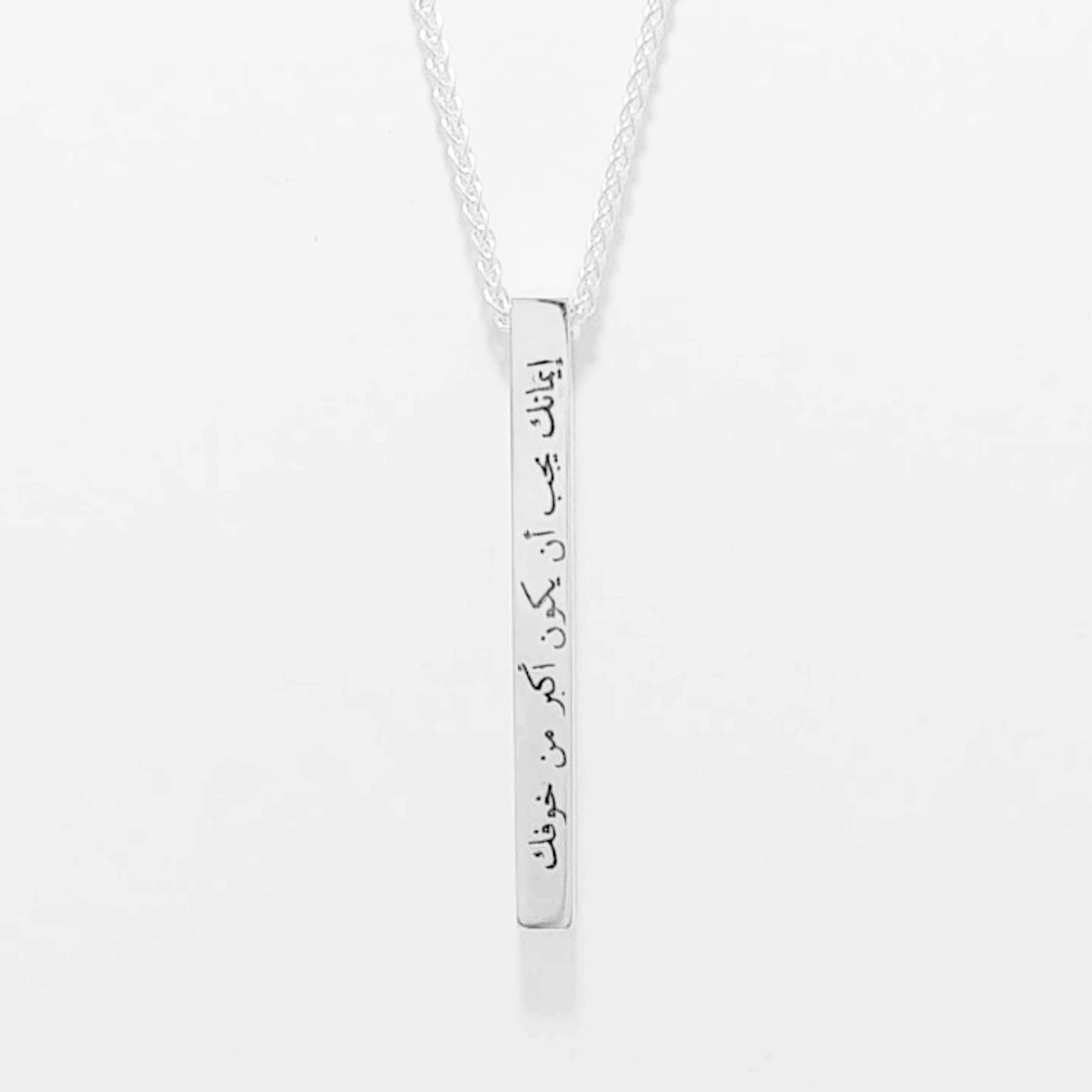
In Arabic script, this gorgeous pendant reads, “Your faith has to be greater than your fear”.

The Faith Necklace is a tribute to the Lebanese People. Handmade and designed with deep purpose. 100% of the profits generated from the sale of this necklace will be donated to The Lebanese Red Cross to support the relief effort in Beirut, Lebanon after the catastrophic explosion that devastated the country on August 4th, 2020.

This explosion killed hundreds, injured thousands and left 300,000 people homeless. The Lebanese people are fighting for their liberties and against the corruption of the system which has forgotten them. All while mourning the loss of their loved ones and putting their lives back together, one brick at a time.

Mavia’s Founder, Jessica Nehme, was born in Lebanon during the Civil War. Her family moved their life to Toronto, Canada to avoid the political and social challenges of their beloved country. Thirty-Five years later, the same challenges not only remain, but have worsened. Out of sadness and a deep call to create something of value and impact, the Beirut Rising Collection was born.

This is the first of three designs to be released, the Faith Necklace is an ode to the strength, resiliency and true essence of the human spirit. It is a reminder to never give up, to keep fighting for what is right, and that when our faith is greater than our fear, we can change the world.

The necklace is available in sterling silver (pendant and chain) as well as gold plated pendant on sterling silver with a gold filled chain. You can shop this collection here and it will also be available through Jewel Envy soon!


Experiments in Plaster: Part 2

By Alex Kinsley

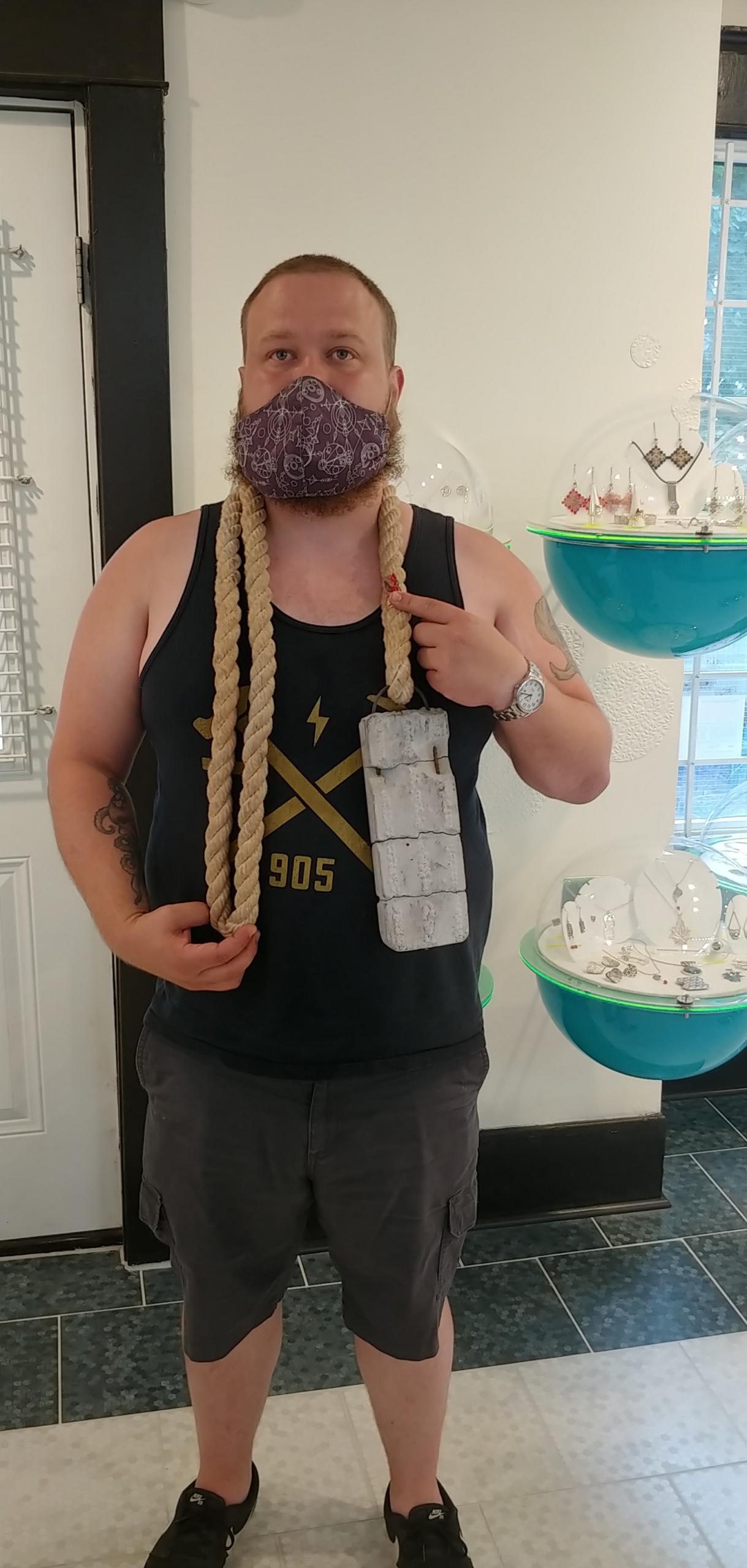
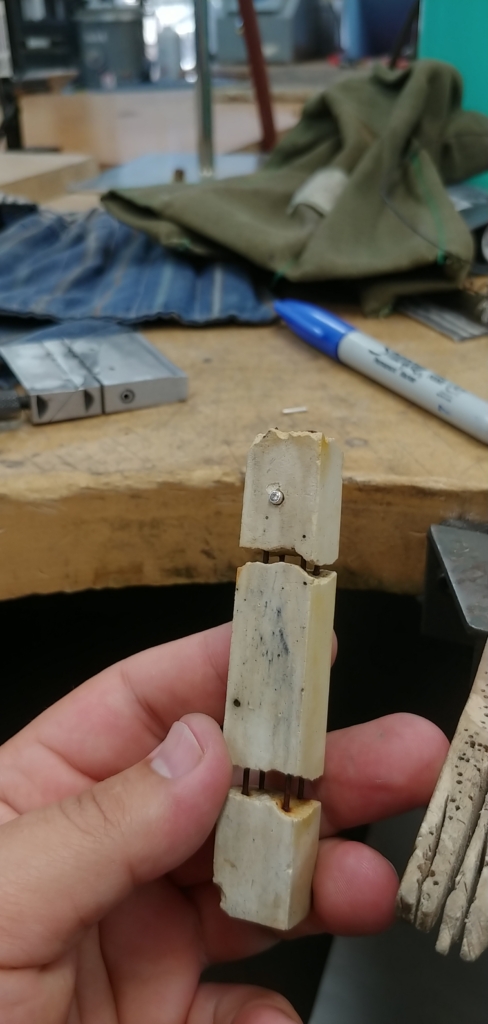
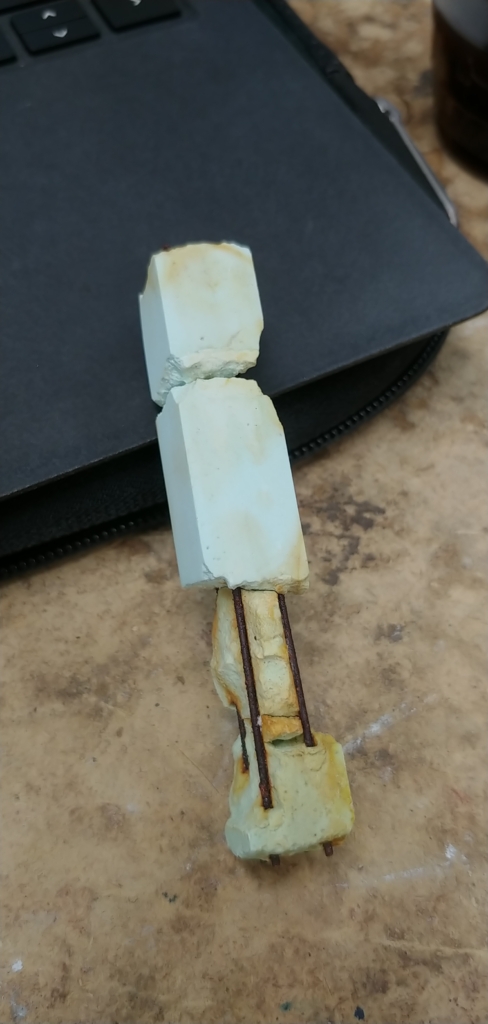
I’m back! With more adventures in the form of plaster, steel, and rust!

The material is quite interesting, I’ve been making use of it’s ability to be dyed with different pigments, and it’s work-ability after it has been cast.

I’ve experimented adding settings to the pieces.
Also some more ‘out there’ dyes!

The next project is a much bigger art necklace, though I’ve still got a ways to go before something fully realized emerges.

New art jewellery from House of Cassady

As an independent goldsmith, I make a fair number of pieces that are small batch productions, so, while they are all unique in their own way, they’re still of a similar design, and generally use similar methods.  Part of my practice, to keep exercising my creative muscles is to challenge myself to make larger pieces on a semi-regular basis.  Last year, I made this piece:

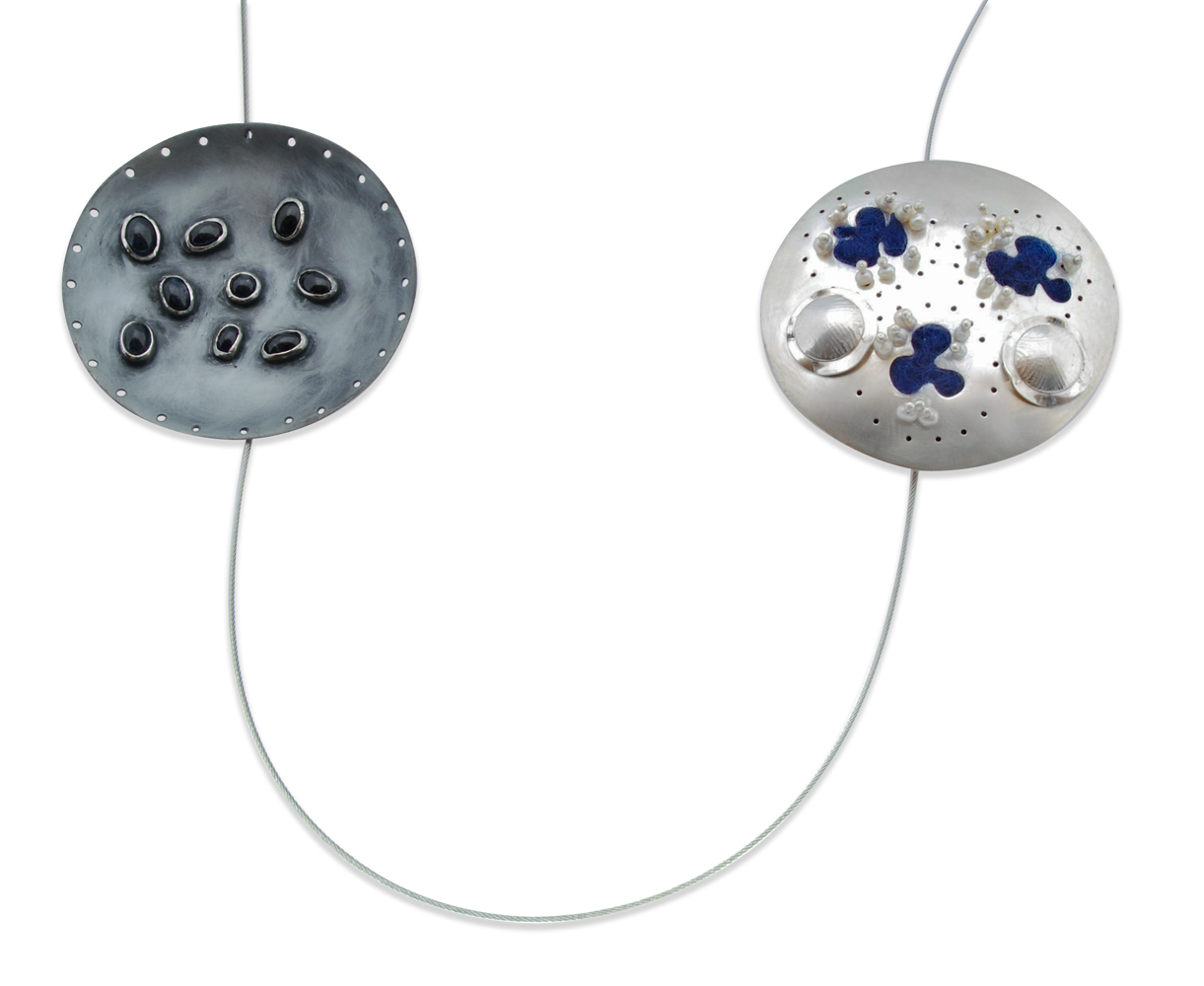
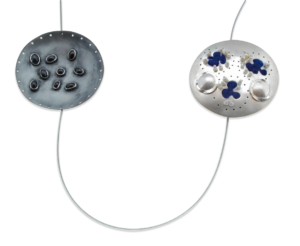
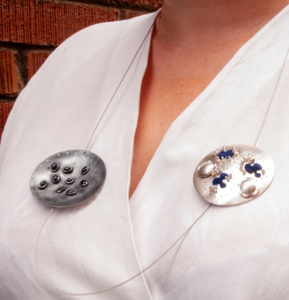
Oxidised sterling silver, 10k yellow gold, blue topaz and sapphire necklace with roller printed elements and two-tone blue needled felt. This necklace is very kinetic, and hangs about 19″ long.

If you’re familiar with some of my work, you’ll see that it incorporates a lot of different elements from other pieces that I’ve made, but puts them together in a new and more elaborate way, incorporating some gold and more precious gems than I might normally use.  (If you’re interested in more information about why I use these elements, you can read a bit more here.)

This year, I set myself a similar goal: to make a larger, statement piece, that incorporates a lot of elements that I normally use, in a larger format, and incorporating or extending my skills at the same time.  This piece presented some challenges for me, in terms of the physical construction, because I couldn’t use a lot of my normal techniques to create the individual pieces.  This made it a lot of fun (I like practical problem solving/troubleshooting), but also rather frustrating at times. 

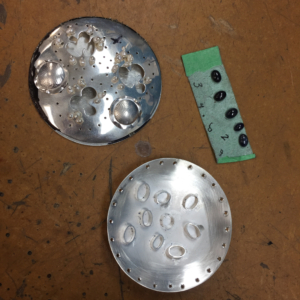
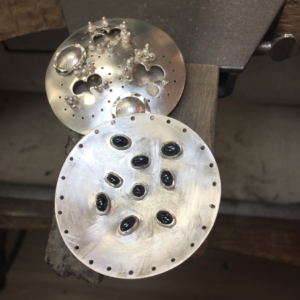
This necklace is part of my sci/art collections, and is entitled Invaders/Defenders. Since it is more specifically an art jewellery piece, the design is associated with different symbolism for me.  The piece has two different finishes.  The oxidised/dark element represents the infectious invaders, with the mostly oval cabochon sapphires being reminiscent of a bacterial shape, and the random placement showing some of the disorder that happens in the infection process.  In contrast, the matte silver/light element represents the immune cells that defend against infection and disease, with the incorporation of texture and irregular cutouts. The more organic nature of the circular shape of the two larger elements reflect the cellular/tissue environment where these biological entities interact, and the two elements are united in a continuous loop with a steel cable, as the different sides of this process are irrevocably linked in biology.

I’m really pleased with the overall effect of the piece, what do you think?  Would you be interested in some smaller pieces in a similar style of one of the elements, perhaps as a brooch or a pendant?

You can contact me here to start a dialogue about this piece, and commission a new work.  I look forward to your comments.

Have a great Saturday!

-Robin

Beauties of the word

I want to share with you today some enlightenment about three of the most beautiful buildings in the world

Tianjin Binhai New Area Library nicknamed The Eye, is a library in Tianjin, China.

The five-level library has a total space of 33,700 square metres. It features floor-to-ceiling, terraced bookshelves able to hold 1.2 million books, and a large, luminous sphere in the center that serves as an auditorium with a capacity of 110 people. The library is nicknamed ‘The Eye’ because the sphere, which appears like an iris, can be seen from the park outside through an eye-shaped opening.
The first and second floors contain mainly lounge areas and reading rooms. The floors above have computer rooms, meeting rooms, and offices. There are also two rooftop patios. Because of a decision to complete the library quickly and a conflict with what was officially approved, the main atrium cannot be used for book storage; the rooms providing access to the upper tiers of shelving were not built and book spines were printed onto the backs of the shelf space for the opening-day photographs.

Tianjin Binhai

Louvre Abu Dhabi-Abu-Dhabi, Arab Emirates.

Fountain of light by Ai Weiwei.
The museum is designed as a “seemingly floating dome structure”; its web-patterned dome allowing the sun to filter through. The overall effect is meant to represent “rays of sunlight passing through date palm fronds in an oasis. The total area of the museum will be approximately 24,000 square metres (260,000 sq ft). The permanent collection will occupy 6,000 square metres (65,000 sq ft), and the temporary exhibitions will take place over 2,000 square metres (22,000 sq ft)

The new museum has a painting called Salvator Mundi, a figurative painting of Christ, is also an extraordinary painting for the new Abu Dhabi museum as an indication of its values of religious tolerance. “Salvator Mundi highlights the inclusive nature of Louvre Abu Dhabi’s narrative and Abu Dhabi’s mission to promote a message of acceptance, and openness,” underlines Al Mubarak. “Having spent so long undiscovered, this masterpiece is now our gift to the world and we look forward to welcoming people from near and far to witness its beauty.”

Louvre Abu Dhabi-Abu-Dhabi

Last but not least, Lacaux IV-Montignac, France

The new International Centre for Cave Art (Centre International d’Art Parietal) in Montignac, France welcomes visitors to an immersive educational experience of the prehistoric Lascaux cave paintings. Known by archaeologists as the ‘Sistine Chapel of Prehistory’ due to their spiritual and historical significance, the 20,000-year-old paintings are among the finest known examples of art from the Paleolithic period.

Lacaux IV-Montignac

Nothing can be more extraordinary than art, paintings, drawings, and sculptures but art includes many other forms of expressions. Art can be music, dance, jewelry, etc,  “something that is created with imagination and skill, and that is beautiful”

Visit us at Jewel Envy. We want to share our “art” with you. We love what we do very much and it’s meaningful because of you!

Have a nice Sunday!

Helena

Our final installment from our intern Siyu! Making a necklace from paper during COVID 19

Hello Jewel Envy Readers!

My name is Siyu and during my final semester of school, while interning at Jewel Envy we needed to stay home due to COVID 19. For our final project we were required to make something at home with limited simple materials. I choose to reuse some paper to make a paper flower necklace. The process was not hard and the results were amazing!

Process:

  • Cut four of the same size square papers and fold three times to be the shape  showed in the images.
  • Cut an angle on every paper to let them all be flower shape.
  • Then cut different parts off to be petals.
  • Use glue to glue every petal together.
  • Use a tool to roll up every petals’ edges.
  • Cut the end of every petal then glue them together.
  • A paper flower is done.
  • use a tool to roll up a long narrow paper
  • Glue the paper rolls to the back center of every flower. A commercial chain or lace ribbon can go though it to hang the flower

Another way to hang the necklace is to cut two narrow symmetrical slits to let a lace ribbon go through every flower.

Artists of Influence…

Yuko Fujita

Yuko is a Japanese artist based in Melbourne, Australia. She initially studied Japanese Literature in Tokyo, but moved to Australia in 2001 to study Jewellery Design. Her work has been exhibited in Europe, Japan, New Zealand and Australia.

“The jewellery I create is much like words and images, but concealed in shapes that are borrowed from nature. I utilise elements such as shape, colour, texture and movement, and transform them into wearable objects that I hope closely engages the wearer or viewer of the piece, triggering an emotional response and inspiration.”

Yuko’s pieces are realised through a spontaneous reaction to her materials, which creates outcomes that are never the same, reclaiming found objects as wearable sculptures. She is interested in making contemporary jewellery that interacts with the wearer. Yuko gives free reign to the interplay between the fundamental qualities of material, texture, shape and colour. Each piece is a tribute to her very personal and charming way of observing the world.

Spoon handles are cut into small faceted beads, like crystals, and painted in botanical greens and reds. Sometimes Fujita leaves her wooden carvings raw, at other times she lightly burns them. The effect is of secret gardens and lost worlds full of seeds, plants and animals, all living in harmony.

She explores the universal void; the feelings of longing and yearning in us all and manages to delicately evoke this in her work, which is often as tactile as it is visually compelling.

“Jewellery is complete when it interacts with the wearer emotionally and physically.”

I admire the beauty in nature. Particularly the botanical world where I like to extract elements such as shape, colour, and texture to create a new identity. By also borrowing from my Japanese literary influences, I use visual language to tell a story through obscure metaphorical forms, so that the wearer can engage with my work using their own interpretation.”

Information for Yuko Fujita provided by Pieces of Eight Gallery, Courtesy of the Artists, The Age and e.g.etal Gallery. You can also check out her blog.

Thanks again for reading!

Karyn aka sticksvsstone

Ruby, The Pigeon Blood Stone of the Gods.

Corundum ruby, 17.30 g, crystal in calcite, collection# 24187, from Kyauksaung, Myanmar. Gift of William F. Larson. Left to right: Collection #33066, oval cut ruby, 1.77 ct, from Myanmar; Collection# 33065 cushion cut ruby, 2.21 ct, from Myanmar; oval cut ruby, 6.32 ct, from Burma, courtesy of Edward Boehm.

I find these blogs just keep getting longer and longer as I add more and more information each month. But, that’s what I love about this, being able to share what I know from the world of gemmology.

July, a hot month for a burning hot stone, figuratively of course. Ruby is known to be the traditional birthstone for July and is the vivid, glowing red variety of the mineral corundum. Rubies are an ancient stone and carry many meanings attached to them, but generally are associated with the sun and blood, thus they symbolize nobility, purity, passion and life. Rubies have a long history, with mentions from the bible and from ancient India. They are especially revered in South-East Asia and India and used to adorn all forms of ornaments and clothes of the royalty of the area. While today there are many locations where rubies have been found and mined, Burma now Myanmar, has been the source of the most desired rubies from as far back as 600CE. It was here the optimal colour, pigeon blood red, was sourced. In days past, a perfect ruby was the colour of fresh pigeon blood on white sheets, morbid but also kind heavy-metal, no? These prized stones hail from the Mogok area of Myanmar (Burma) and while Mozambique and Sri Lanka are also hosts of beautiful rubies, the Burmese name will cost you more. Think of it as buying a brand name for shoes or clothes over no-name, Burmese rubies are like the Gucci, Dior and Prada of rubies.

Natural, untreated pigeon-blood ruby of Mogok, Myanmar.

Ruby is identified as:

  • 1) Trigonal Crystal System, not to be confused with crystal habit. (Note, habit is how the mineral crystallizes)
  • 2) Oxide Composition, 
  • 3) Simple Oxide Family
  • 4) Mineral = Corundum – Al2O3
  • 5) Variety = Ruby.   

Like beryl, corundum is naturally colourless, and thus colour comes from impurities within the stone. Ruby is the red-crimson variety, sapphire is the blue variety and padparadscha is the pink/orange variety. All other colours are classified as “fancy sapphire”, this is odd as the beryl varieties had unique names but when it comes to corundum in the yellow, violet or green hues then they are referred to as a “yellow sapphire”, “green sapphire”and “violet sapphire”. Confusing, I know, even to a gemmologist. Unless a colour is in front of the word “sapphire” then it is assumed one is referring to the blue variety of corundum.   

The man colours of corundum. Blue sapphire and sapphire alone refer to the same colour.

Now for the fun part, how is ruby so red? Ruby, (derived from ruber; Latin for “red”, big surprise there) gets its colour from traces of chromium, within the crystal structure. Remember our blog from May and June, chromium is a very colouful element. Green in emeralds and colour change in alexandrite. This element does more than just give you a shine on your wheels. As started before this colour all comes down to how light interacts with chromium ions, chromium(III) to be specific, within the crystal lattice. Without getting too technical, when chromium is in corundum it will replace an aluminum ion and the distortion causes the chromium electrons to absorb the ultraviolet, violet, and yellow-green regions of the spectrum. If one percent of the aluminum ions are replaced by chromium in ruby, the yellow-green absorption results in a red color for the gem. With emeralds, the chromium absorbs more of the violet and yellow-red wavelengths of visible light, thus we see green. 

Now, let’s get serious about rubies.  With the high price of rubies, some exceeding far beyond the cost of diamonds even, there are many treatments, synthetics and imitations to watch out for when hunting for rubies. First, some terminology needs to be explained, mainly the terms “natural”, “synthetic”, “imitation” and “treatment”. A natural gemstone refers to a stone made from the earth and is what most people desire/expect. A synthetic gemstone is an identical copy of a natural, just made by man. This means it has the same chemical formula and crystal structure as its natural counterpart. Ideally, the term “synthetic” should only be used if the man-made stone has a natural counterpart. If there is no counterpart, then this stone is referred to as an “imitation”. An imitation is a stone or material representing another stone. Imitations can be natural or synthetic and confuse many people. Cubic zirconia is one of the most common samples for imitating precious stones. Treatment or a treated stone is a natural stone that has been tampered by humans to improve colour saturation, clarity, and durability. There are many interesting ways we have discovered to help improve the natural beauty of precious stones. 

For rubies, the most common treatment you will see is heating and assembled rubies. Heat treatment is as the name suggests. The rubies are slowly heated up to a temperature of 1800 °C. The heat helps eliminate inclusions and can enhance the colour of the stone. An assembled ruby is actually ruby grains assembled with leaded glass and coloured with a variety of elements, like copper, boron, sodium, calcium or potassium. This is a 4 step process and commonly used to fill fractures within the ruby. Oiling is another treatment used on rubies but not as common as with emeralds. The stone is placed in heated oil in a vacuum chamber and the oil is then drawn into the cracks of the stone or it is ground while the stone is being cut. All of the treatments are used to help increase the clarity and colour of the ruby as a clear and vibrate stone is the most desired. 

Before and after glass-filled ruby treatment.

Now for the best part, how can one tell if their ruby was treated, synthetic, imitation or a natural red wonder? Well the most obvious answer is get a professional to look at it. Second, like with all gemstones look at the cost. If the price is too good to be true then it probably is. Sometimes traders don’t know their material and this can work in your favour or against you, buyer beware. If you have a loupe or a strong magnifying glass there are a few things you can look for in your ruby. For the assembled or glass filled rubies the difference in lustre between the glass and the ruby can help in identification. With a loupe, looking at the light reflected off of your ruby, examine for cracks and fractures, if you see a difference in lustre, or shine, the duller material is the glass and the brighter material is your ruby. You may also see bubbles in your filled fractures from the glass. 

Microscopic view into an assembled (glass-filled) ruby. Air bubbles within the glass gives it away as round bubbled never form within natural minerals.

For heat treatments you need a microscope but if you happen to see inclusions in your ruby, especially other minerals look at the crystal surrounding the inclusion. If you see cracks or minor fractures radiating out from an inclusion, like a lily pad, that is possible evidence of heat treatment. The heat caused the inclusion to expand and contract at a different rate compared to the rest of the ruby, thus stressing the ruby and causing it to crack. You may also see “healed” fractures but alas you will need a professional eye to show you what I’m referring too. Oiling is fairly easy to identify as your hand/fingers may become red after handling the stone. You will also notice with your loupe that the colour of the stone is concentrated along fractures within the crystal.  

Flux-melt ruby to the left and flame-fusion boule to the left. The cut stones are faceted examples of each.

Now what about natural vs synthetic rubies. A flawless gem is the most prized gem but also one of the most difficult to identify as inclusions help greatly. When it comes to synthetic stones, you’ll need a microscope to discern the origin of your ruby. All gemstones leave clues as to how they formed within the crystal structure and carry trace element signatures. While the chemical signature is the best way to identify a stone’s origin you have to destroy a piece of your stone. I don’t think many people would be interested in having a hole in their $30,000 ruby to see if it’s natural or synthetic. Thus by using high powered microscopes and polarized light, gemmologists can see signatures as to how gemstones crystallized and your stone is left untouched. Synthetic rubies are produced either through the flux-melt method or flame fusion method. These methods should be disclosed when selling synthetic/lab-created rubies and if not, ask. Since I will be talking about sapphires in September, I will focus on the flame-fusion process here and the flux-melt there.   

A diagram showing how flame-fusion corundum is made. This process was made possible by the French Chemist Verneuil. The hammer vibrates the powered at a controlled rate which then drops and melts onto a growing, rotating synthetic ruby.

The most common synthetic ruby is the flame-fusion ruby, a process improved upon by the french chemist Auguste Victor Louis Verneuil to start producing synthetic ruby and sapphire in mass quantities. In a nutshell, the stone is grown like a stalactite, from the base up. Aluminum oxide (corundum) powder and chromium oxide (red colour) are mixed together and then sprinkled at a controlled rate through an oxyhydrogen flame and heated to 2200℃. The now liquid droplets of ruby then fall onto a seed crystal and the ruby begins to grow. The end result is a ruby or sapphire boule. The reason this process is so popular is because the crystals grow at an alarming rate. A typical 40 by 80mm boule weighing 250-500 carats would take 4 hours to create. This process works for creating synthetic spinel as well. Little fun fact here, while you can create ANY colour of sapphire, chemists are still unable to create an emerald green sapphire. Today the yearly, world production of flame fusion corundum due to Verneuil work totals over 1 billion carats, most used in watches, lenses and manufacturing.  

Two distinguishing featured found within the flame-fusion ruby. The curved striae are visible in the background and the cylindrical bubbles in the center.

The rubies created by the flame-fusion process are grown, layer by layer. These layers are actually curved called “curved striae” and a distinguishing feature of the ruby as each layer is built upon the last layer and oozing over it, like a tower of pancakes. Now a hard fact here. Nothing in natural minerals is curved when you’re referring to the growth of a mineral (fractures are the exception but that’s for another time). Now these curves are usually only visible with a microscope unless it was a rushed crystal. Other features would be inclusions of bubbles or unmelted powder sprinkled within the ruby. 

How pleochroism is expressed in a natural vs flame-fusion ruby. Also how gem cutters maximize carat from each crystal.

Another way to tell these synthetics from naturals is if you look through the table of your stone with a dichroscope or using a polarized lens/glasses. If you see your stone strongly change colours as you rotate it with light from behind, you may have a synthetic. Reason for this is because of the structure of the boule. While ruby and sapphires are hard, they can be brittle, and when you’re grown in an unnatural way, you’re going to be unnaturally brittle. To prevent this, split the boule down the middle once it’s done crystallizing. This releases the tension built up in the curves layers. The changing colour comes from a property all crystals have, well all but the cubic crystal system (they’re special), called pleochroism. In short this means the atomic structure of crystals can split light into two waves, the short and long wave, due to the duality nature of light as an elector-magnetic wave/particle. In turn you will see some stones change colour depending on the angle of the stone to your eye. Ruby, being a trigonal stone, has this property and when viewed from the side as opposed to down the “optic axis” (the angle at which both light rays are at the same speed and thus don’t split). I know there’s a lot here but add this all up together knowing the fact that the boules grow along the optic axis as well. Thus when you split the boule, your largest surface is now the split side. Gem cutters then use this side as the table face to save carats. This face is perpendicular to the optic axis thus pleochroism is as its highest value, ot more noticeable. SCIENCE AND LIGHT!!!

Looking at a ruby with a dichroscope perpendicular to the optic axis. This is what you will see if you are looking directly at the face of a flame-fusion ruby.

Now if you want to search for your own ruby, just like all the other precious stones out there, it is a buyer beware world out there. Ask questions, and use your gut first. Also look at the name. Many stones have the name “ruby” in them in order to make you think they are related. The infamous Balas Ruby in the Royal British Crown is actually a red spinel. Rubellite is a pink/red variety of the tourmaline family. Again if it’s synthetic, the process should be indicated with the purchase. Imitation stones will be easier to spot as they will not be as hard or will not show the pleochroism. 

Star ruby displaying natural growth rings. A true wonder of light and colour.

What about star rubies? Yes they exist naturally and are the result of thin mineral hairs of rutile crystallizes alongside the triangular habit/system of the mineral. When these hairs are cut into a dome or cabochon shape along with the rest of the ruby, the hairs will reflect light like a spool of thread. With three spools comes three reflections thus we see a star. This is a phenomenon known as asterism, and if there is only one reflection like a slit, it’s known as chatoyancy, or ‘cat’s eye’.      

While these are just some quick pointers for general interest if you are interested in more information I suggest some of the links and books below. 

https://en.wikipedia.org/wiki/Ruby

Wikipedia, though not officially credible, it’s a great place to start. Also look at the reference they use.  

https://www.gia.edu/ruby

GIA encyclopedia page for rubies. Very friendly for just starting to understand gemstones with links to countless articles about ruby mines, unique specimens, ruby history, lore and more.

Gemmology by Peter read – A gemmologist bible, make sure to look for the latest addition as there is always new information to be added to textbooks. This book covers ALL the gemstones as well as how to use the tools to identify naturals, synthetics and imitations. Warning this book is very technical. 

Jewels: a secret history by Victoria Finlay – an excellent read into the history and lore behind some of the more renowned gemstones.  

Well that was a novel and a half, I hope you enjoyed this blog about the July stone, Ruby. In August I will be informing you about Peridot, the olive-lime green gemstone of the deep earth. 

Peter

×
Product added to cart

No products in the cart.